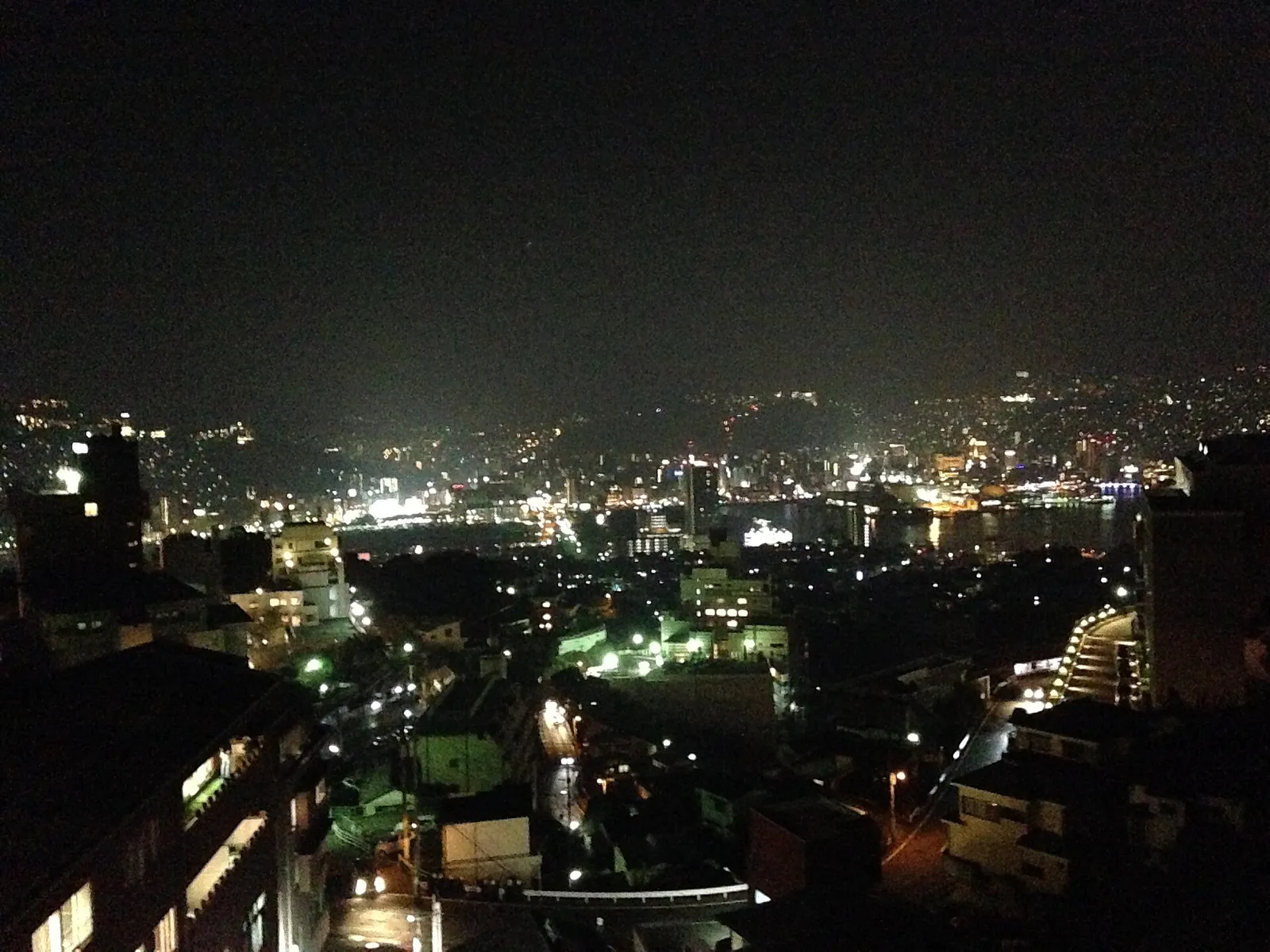
Nagasaki is Japan's most cosmopolitan historical city, and it earned the title the hard way: for over two centuries of national isolation this was the only place in the country where Westerners (a handful of Dutch traders on the artificial island of Dejima) were permitted to live, and the port's layered inheritance shows it - Chinese temples, a Scottish merchant's hillside villa, the oldest Christian church in Japan, and a food culture split between champon noodles and Portuguese castella cake. Beneath the harbor charm sits the second atomic bombing, whose memorials center on Urakami, the Catholic district that was ground zero. Between them, the city delivers hillside streetscapes, one of Japan's three great night views, and an emotional depth few cities can match. Best for second-time visitors to Japan and history-minded travelers.
Top sights at a glance
No. 1
Nagasaki Peace Park & Atomic Bomb Museum
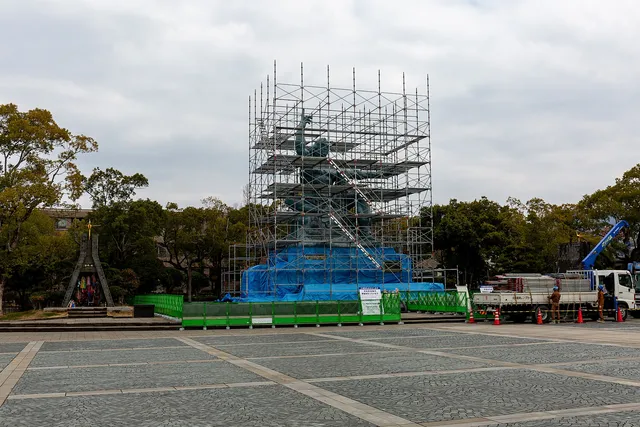
The memorials to the atomic bombing of August 9, 1945 sit in Urakami, several kilometers north of downtown - not at the city center as in Hiroshima, because the bomb fell on what was then a village of Catholic families whose cathedral, the largest in East Asia, stood at the hypocenter. The museum tells that community's story alongside the bomb's: the restored Peace Statue with its one horizontal and one vertical hand, the black monolith marking the hypocenter, and a surviving column from the original Urakami Cathedral. Where Hiroshima's narrative centers on one morning, Nagasaki's is inseparable from 300 years of Christian history that ended and restarted here.
Good to know · Museum entry is 200 yen; hours 8:30-18:30 (until 17:30 September-April), closed December 29-31, as of October 2026. Allow two to three hours for museum, hypocenter park, and memorial hall combined. Take tram 1 or 3 to Matsuyama-machi, about 15 minutes from Nagasaki Station. Visit in the morning, then let the afternoon be something lighter - the harbor and Glover Garden are the city's own answer.
No. 2
Glover Garden
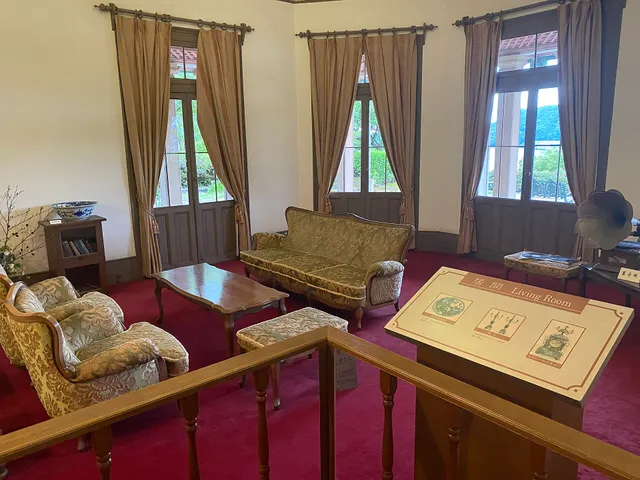
An open-air museum on the hill above the harbor where the foreign merchants of the 1860s built their houses, assembled from the city's surviving Western residences. The oldest is the Former Glover House, believed to be the oldest wooden Western-style building in Japan, home of the Scottish trader Thomas Glover - shipbuilder, brewery pioneer, and quietly, an arms supplier to the revolutionaries who overthrew the shogunate. The garden's paths, stone stairs, and harbor views make it the most purely pleasant sight in the city, and the Meiji-era industrial story it tells is now UNESCO-listed.
Good to know · Entry is 1,300 yen; hours 8:00-18:00 in the base season, with long summer openings to 21:30 from mid-July to mid-October (check the seasonal calendar), as of October 2026. The entrance sits beside Oura Church, a 5-minute walk from the Ouratenshudo-shita tram stop - pair the two in one morning. Two escalators and elevators make the hillside manageable; the stone paths between houses are cobbled.
No. 3
Dejima
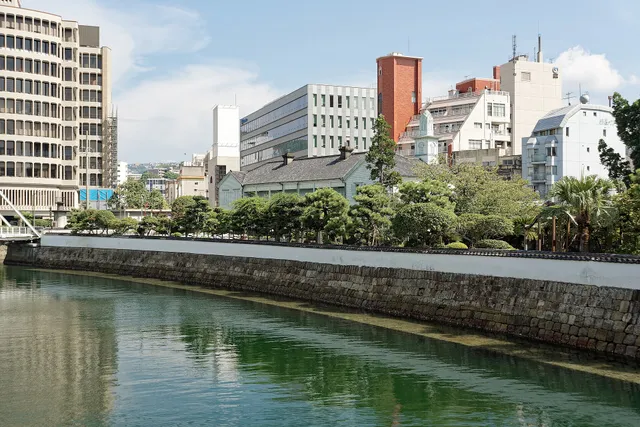
The fan-shaped artificial island, built in 1636 to imprison Nagasaki's Portuguese traders, that became Japan's single Western window for the 218 years of national isolation: after the Portuguese were expelled, the Dutch East India Company's factory moved in, and for two centuries the language, medicine, and science of Europe dripped into Japan through a compound the length of two city blocks. The island lost its water to land reclamation long ago, but decades of reconstruction have raised its walls, warehouses, and residences again, and walking it - Dutch brick, tatami floors, the chief factor's desk - is the most compact history lesson in Japan.
Good to know · Entry is 1,100 yen; open 8:00-21:00 (entry until 20:40) daily, as of October 2026 - the evening hours make it a rare sight open after dinner. It sits directly beside the Dejima tram stop, 5 minutes and 140 yen from Nagasaki Station. Free audio guides in English are worth collecting at the gate; allow 60-90 minutes. The on-site cafe occupies a reconstructed warehouse.
No. 4
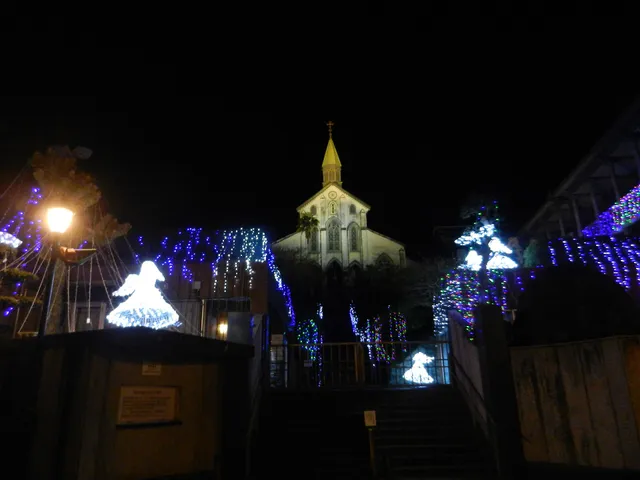
Oura Church
The white Gothic church raised in 1864 by a French missionary for the foreign community of the newly opened port - and the stage, months later, for one of the most extraordinary scenes in Japanese history: a group of Urakami farmers quietly told the priest that they were Christians, descendants of communities that had survived 250 years of prohibition in secret. The 'discovery of the faithful' proved the hidden-Christian tradition alive; the church, now a National Treasure and the anchor of a UNESCO World Heritage listing, holds a museum on that history in the buildings beside it.
Good to know · Entry is 1,000 yen including the Christian museum; hours 8:30-18:00 (until 17:30 November-February), as of October 2026, with rare irregular closures. Photography is not permitted inside the church itself. From Nagasaki Station take tram 5 to Ouratenshudo-shita (about 15 minutes); the church sits at the foot of Glover Garden. Show 「大浦天主堂はどこですか」 at any hotel desk if lost - or just follow the spire.
No. 5
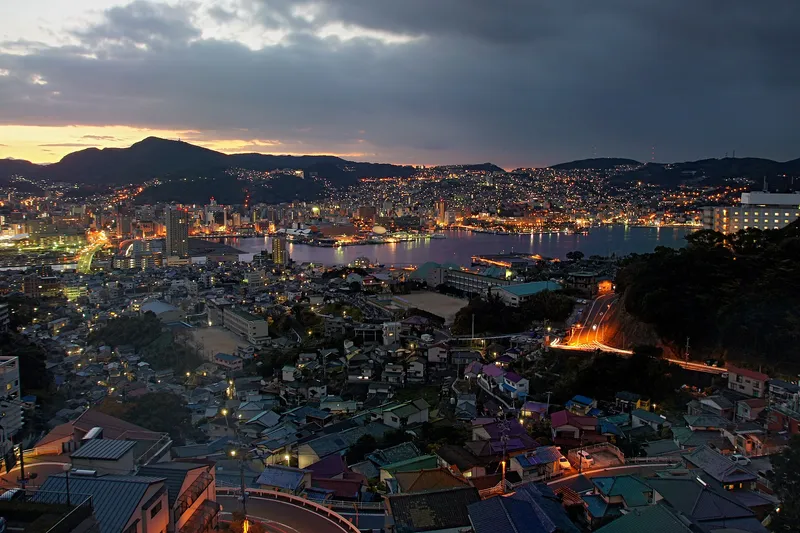
The Night View from Mount Inasa
The 333-meter summit above the harbor shares, with Mount Hakodate and Mount Rokko, the title of one of Japan's three best night views - and partisans argue it is the best of the three, because Nagasaki's lights stack in layers: the harbor's arc of warehouses and cranes, the apartment towers climbing the surrounding hills, and the peninsulas reaching into the dark sea. The 5-minute ropeway ride lifts you from the hillside to the outdoor deck, which curves around the summit. Go for sunset, stay for full dark, and let the geography explain the city you spent the day walking.
Good to know · The ropeway runs every 15-20 minutes, 9:00-22:00; round trip 1,900 yen, one way 1,040 yen, as of October 2026, with an annual maintenance closure around early June to early July. From Nagasaki Station, take the bus toward Inasa Ropeway (160 yen, 5 minutes) or walk 15 minutes from the Takaramachi tram stop. Evening free shuttles tie the ropeway base to major hotels and the station in high season.
See it in motion
Some places earn a moving picture
Stills can't show how this place moves — the drift, the light show, the crowd flow. We picked a recent, high-quality walkthrough rather than a promotional cut.
4K Japan Walk 🇯🇵 1 Hour Walking Tour in the Evening in Downtown Nagasaki - Jan 2025【4K HDR 60fps】
4K Walking Travel · YouTube · plays on click
Embedded via YouTube's official player (privacy-enhanced mode). Video: 4K Japan Walk 🇯🇵 1 Hour Walking Tour in the Evening in Downtown Nagasaki - Jan 2025【4K HDR 60fps】 by 4K Walking Travel. Not affiliated with Japan Travel Navi; screened for quality and accuracy on 2026-10-06.
Most Japanese port cities opened in the 1850s; Nagasaki opened in 1571, and the difference shows. For most of the two centuries that Japan closed itself to the world, this was the single crack in the wall - Dutch traders confined to one artificial island, Chinese merchants in their own quarter across the river - and everything that leaked in, from Western medicine to Chinese temples to Portuguese cake, stayed and became local. The city you walk today is those layers: church spires and temple roofs in the same view, a Scottish merchant’s villa above the harbor, and a noodle dish that could only be invented where cultures mix. Nagasaki also carries the second atomic bombing, told here through Urakami, the Catholic district that was ground zero. Give it two days - the first for the harbor and its histories, the second for peace park morning and the night view - on the western arm of our Kyushu onsen loop, an easy ninety minutes from Fukuoka.
A Bit of History
The Portuguese arrived in the 1540s with Jesuit missionaries in tow, and in 1571 the fishing village of Nagasaki was opened as their port. For a few decades it became something Japan had never seen: a Christian town, its churches so numerous the hillsides were compared to a seminary. The reaction was violent. Toyotomi Hideyoshi banned the faith in 1587 and crucified 26 missionaries and believers in Nagasaki in 1597 - the Twenty-Six Martyrs still memorialized on the hill above the station. Under the Tokugawa shogunate the repression hardened into a national ban, and Japanese Christianity went underground for 250 years, most completely in the villages around this city, where families passed the faith in secret for ten generations.
The same regime that banned Christianity monopolized it: from 1636, all Western contact was funneled to Nagasaki, and then to Dejima, an artificial island built to hold first the Portuguese and, after their expulsion, the Dutch East India Company. For the 218 years of isolation, Dejima was the sole Western outpost in Japan - the source of the European medicine, astronomy, and ‘Dutch learning’ that kept Japanese science alive - while across the canal, the Chinese community ran its own trading quarter and built the temples that still stand. Nagasaki in 1800 was, by population share, the most foreign city in Japan.
Gunboat diplomacy reopened the country in the 1850s, and Nagasaki’s foreign quarter boomed: Western merchants built villas on the hills, Thomas Glover helped found the shipyard that became Mitsubishi’s, and the port’s mixed inheritance - Dutch Slope, Chinese halls, Catholic and Anglican churches - took its modern shape. The industrialization it fueled, from shipyard to coal mines, is now a UNESCO World Heritage listing of its own.
On August 9, 1945, three days after Hiroshima, the second atomic bomb fell on Urakami - a Catholic district in the city’s north, whose cathedral was then the largest Christian building in East Asia. Some 70,000 people had died by the year’s end, and the rebuilt Urakami Cathedral anchors the peace park today. The postwar city rebuilt around its harbor and shipyards, and its layered past - rather than any single era - is what it now shows visitors. For Hiroshima’s memorials, see our Hiroshima page; Nagasaki’s deserve their company, not their repetition.
Culture & Daily Life
The word locals reach for is saikai - ‘cross-cultural exchange’ - but the daily reality is simpler: Nagasaki looks like a port town where everyone stayed. The Chinese community’s temples (Sofukuji, with its Southern-Chinese architecture, is the famous one) sit minutes from Dutch Slope’s stone-paved lanes and the Western houses of the Glover hillside; the cuisine is a three-way fusion; and the city’s biggest festival, the Kunchi in early October, sends Japanese floats, Chinese dragon dances, and Dutch ‘ship’ performances through the same streets in a program that has run since the 1600s.
Daily life runs on the trams: five single-track lines threading the narrow city, a flat 150 yen a ride, entered at the back and paid at the front. The city is long and thin - the harbor defines everything - and the trams connect the station, Chinatown, Dejima, the Glover hillside, and Urakami in a line, 15 to 25 minutes end to end. English signage is thin away from sights; the station tourist offices hand out good English maps, and the network is legible once you have ridden it twice.
The other daily texture is the topography: Nagasaki is Japan’s San Francisco in miniature, houses stacked on hillsides around a finger of sea, stone-paved slopes (the Dutch Slope is the polished one, but dozens are ordinary streets) climbing between neighborhoods. Residents climb them daily; visitors should at least once, ideally toward sunset. The city’s Catholic parish life continues beneath the sightseeing - Urakami’s rebuilt cathedral holds mass, church bells are part of the ambient sound almost nowhere else in Japan, and a working Christian community lives on in the prefecture, descendants of the families who came in from hiding in the 1860s and 1870s. Festivals complete the calendar: the Kunchi in early October is the peak, the Lantern Festival fills Chinatown with Chinese lanterns for the two weeks of Lunar New Year, and the harbor’s summer fireworks are the standard big-city summer night.
Nature & Day Trips
The signature excursion is Gunkanjima - Battleship Island - the abandoned offshore coal island whose concrete apartment blocks, empty since 1974, have made it one of the world’s famous ruins. Boat tours run from Nagasaki’s port, landing on the island when seas allow; they book out days ahead in high season and cancel in weather, so reserve early in your stay and treat landing as a bonus. The island’s mines were part of the same Meiji industrial story as Glover’s shipyard, and the UNESCO listing covers both. The harbor crossing itself, past Mitsubishi’s working shipyards, is half the value of the trip.
The closer classic is Mount Inasa, covered as a sight below - but the mountain is also the city’s green escape, with hiking trails from the ropeway base. Across the harbor, the peninsula road leads to Nomozaki’s coast and lighthouse in under an hour by bus, with the Sakito islands’ clear-water beaches beyond. A different order of day trip goes inland by highway bus to Unzen’s volcanic hot springs, or by train up the Omura Bay coast - both about ninety minutes, both tying into a Kyushu circuit. In spring, Omura Park, half an hour away, is one of Kyushu’s best sakura spots.
Food & Drink
Start with champon, the city’s signature: a bowl of noodles in pork-and-chicken broth piled with seafood, pork, and vegetables, invented around 1899 by a Chinese restaurant owner feeding Chinese students on a budget - a proper bowl still costs under 1,000 yen. Its crisp-fried sibling is sara udon, the same toppings over a nest of thin fried noodles; every Chinese restaurant in the Shinchi Chinatown grid and beyond keeps its own ratio. Castella, the Portuguese-derived sponge cake brought by missionaries in the 1500s, is the city’s sweet signature - sold in long boxed slabs, best eaten fresh and slightly warm rather than vacuum-packed for the flight home.
The deeper tradition is shippoku, the banquet cuisine that grew from Chinese and Dutch influences on Japanese tables: soup, sashimi, and stewed dishes served together at a round table, booked ahead at a handful of old restaurants, and the most complete edible expression of the city’s history. Toruko rice - pilaf, spaghetti, and a breaded pork cutlet with curry on one plate - is the beloved, calorically serious descendant of yoshoku culture here, again with each restaurant guarding its version. Order champon or sara udon by pointing at the food models, or show 「ちゃんぽんを一つ、お願いします」 at any counter.
Between meals, walk the Chinatown arcades for kakuni-manju (braised pork belly in a steamed bun) and the market streets off the covered arcade for the day’s catch; the prefecture’s islands supply sea bream, squid, and Hirado beef. Turkish-round lokum is not local, but the Turkish rice is. For drinking, Kyushu shochu is the regional default and the local barley and sweet-potato pours are honest and cheap; an izakaya dinner with them runs 2,500-4,500 yen, and the shippoku dinner, 6,000-10,000 yen, is worth one splurge. Castella makers sell thick fresh-cut end slices at their counters, a local habit worth adopting.
Top Sights
Nagasaki Peace Park & Atomic Bomb Museum
Arrive by tram to Matsuyama-machi and the sequence begins at the Atomic Bomb Museum (200 yen, 8:30-18:30, until 17:30 September-April, closed December 29-31, as of October 2026): a descending exhibition hall that follows the bombing from the morning of August 9, 1945 - cloud cover over the primary target shifted the aim to Urakami - through the heat, fires, and aftermath, told with the belongings of the dead and objects rescued from the cathedral. The National Peace Memorial Hall next door is a quieter, underground counterpoint.
Outside, the walking axis runs: the black hypocenter monolith on its green mound, the fountain, and the giant Peace Statue at the far plaza. What distinguishes Nagasaki’s memorials from Hiroshima’s is the frame: this ground was a Catholic village, destroyed in the year the community had finally rebuilt its cathedral after 250 years underground - the story the Oura Church museum tells from the other end. The two cities’ museums are not redundant; budget the morning, keep the afternoon light.
Glover Garden
The hillside above Oura Church holds the Western merchants’ world of the 1860s-1900s, assembled as an open-air museum: the Former Glover House at the top - Japan’s oldest wooden Western-style residence, its lattice-veranda blend of Japanese carpentry and colonial plan unmistakable - surrounded by the relocated Ringer and Alt houses, walkways, and planting that make it closer to a strollable garden than a museum. The harbor views are the finest in the city, down over the shipyard cranes to the sea - and they are, in effect, the exhibit: this harbor made these men rich.
The human story is worth the English signage: Glover arrived at nineteen in 1859, stayed fifty years, helped found the shipyard and the brewery that became Kirin, and backed the samurai revolutionaries of the Meiji Restoration. Two hours is right; come late in a summer day, when the late openings (to 21:30 mid-July to mid-October, 1,300 yen) let you walk the villas in lamplight with the harbor turning gold below.
Dejima
Begin at the bridge, crossing reconstructed canal water - the island’s original moat, reclaimed from the land reclamation that buried it. Inside, the fan-shaped street plan holds warehouses, clerk’s quarters, and the chief factor’s residence furnished in Dutch domesticity, alternating with tatami rooms for the Japanese staff who ran the interface. Scale is the revelation: the entire Western presence in Japan, for two centuries, lived on two city blocks.
Give it 60-90 minutes with the English audio guide (free at the gate), reading the exhibits on what actually passed through: medical texts, telescopes, the annual court journey to Edo. The site is open 8:00-21:00 (entry until 20:40), 1,100 yen, as of October 2026 - the evening hours are a rarity, and the walls lit at night, five minutes from Chinatown, make an after-dinner visit the practical choice.
Oura Church
The church stands at the foot of the Glover hillside, a white Gothic building of 1864 facing the harbor - built for the foreign community, and famous for what happened months after its consecration, when a group of Urakami farmers revealed to the French priest that they and their ancestors had kept the Christian faith in secret through 250 years of prohibition. The ‘discovery of the faithful’ began the end of the hidden tradition; the church became a National Treasure, the first Western-style building so designated, and anchors the region’s UNESCO World Heritage listing.
The interior is small and quiet - stained glass, a French altar, no photography - and the museum beside it carries the story outward: the martyrdoms, the hidden villages, the twentieth century. Entry is 1,000 yen including the museum, 8:30-18:00 (until 17:30 November-February), as of October 2026. Pair it with Glover Garden in one morning - the gate is fifty meters uphill - for the whole foreign century in three hours.
The Night View from Mount Inasa
The ropeway’s gondolas climb from the hillside base to the 333-meter summit in five minutes, and the deck at the top curves around a full circle of view: the harbor and its peninsula arms, the city stacked up the amphitheater of hills, the sea beyond. At dusk the geometry explains itself - why the Chinese quarter, why the Dutch island, why the shipyards - and after dark the view takes its place among Japan’s official three best night views, with partisans calling it the finest.
The practical plan: bus or taxi to the ropeway base (the bus is 160 yen and 5 minutes from the station), ride up thirty minutes before sunset, and descend by 20:30 to beat the crowd - or stay later; the deck is open until 22:00. Round trip is 1,900 yen (one way 1,040 yen) as of October 2026; the maintenance closure runs about a month from early June, so midsummer visitors should verify dates. The free evening shuttle from major hotels and the station makes this the easiest of the three night views to visit without a car.
Getting There & Around
Since 2022 the fastest route from Fukuoka is the Nishikyushu Shinkansen: Relay Kamome limited express from Hakata to Takeo-Onsen, same-platform transfer, then 25 minutes to Nagasaki - about 85 minutes total and around 6,500 yen one way, fully reserved on the shinkansen segment (as of October 2026). The JR Kyushu North Pass covers it. Nagasaki Airport, on its own island in Omura Bay, connects to Nagasaki Station by bus in 45 minutes at 1,200 yen, departures every twenty minutes - an easy arrival by Japanese airport standards.
In town, the trams do the work: a flat 150 yen per ride regardless of distance, or a 600-yen day pass that pays for itself in four rides. Board at the rear, exit at the front, pay the driver; transfers at the Chinatown and Shin-kaikan interchanges are free within 30 minutes if you tap an IC card (Suica and its siblings work; paper transfer tickets were abolished in 2021). The five lines cover every sight in this article except the Inasa summit bus. Taxis are metered and reasonable for hillside shortcuts.
Where to Stay
Stay near Nagasaki Station for logistics: the airport bus, tram hub, and shinkansen-era hotel stock, with the Dejima and Chinatown sights a short tram ride - or a 15-minute waterside walk - south. The immediate station blocks are functional; walk three minutes toward the waterfront for the better hotels and harbor views.
The atmospheric base is the Glover Garden and Minami-Yamate hillside: a handful of boutique conversions in old Western houses and low-rise hotels under the church spires, with the harbor below and the night-view ropeway next door. It trades convenience for character, and the last trams back up the hill end by around 23:00.
The third option is the Hamamachi and Shianbashi district between Chinatown and the station - the old downtown, its shopping arcades and izakaya lanes livelier at night than anywhere else in the city, with business hotels above. Families and long-stayers should note the hills: any hotel described as ‘hillside’ in Nagasaki means it, and luggage climbs better by taxi.
Sources & verification (9)
- https://www.japan-guide.com/e/e2162.html
- https://www.japan-guide.com/e/e4400.html
- https://www.japan-guide.com/e/e4406.html
- https://www.japan-guide.com/e/e4407.html
- https://www.japan-guide.com/e/e4408.html
- https://www.japan-guide.com/e/e4410.html
- https://www.japan-guide.com/e/e4412.html
- https://www.japan-guide.com/e/e4420.html
- https://www.glover-garden.jp/guide/