Trains, Shinkansen and IC Cards: Riding Japan's Railways in 2026
Japan's trains are the best in the world and almost the easiest — once you know the flow. This guide walks through buying and boarding a Shinkansen step by step (ticket machines, reserved seats, the smartEX app, oversized luggage rules), sets up your IC card with the 2026 options — Welcome Suica, the Welcome Suica Mobile app for iPhone, or a regular Suica in Apple Pay — and explains what IC cards can and cannot do, from convenience stores and vending machines to why you cannot tap one from Tokyo to Kyoto. Includes Tokyo Subway Ticket pricing and when it pays off. Fares and card rules as of October 2026.
The short version
- For Shinkansen, book reserved seats: buy at a green-ticket machine or office, or register on the smartEX app (Tokaido/Sanyo/Kyushu) and tap through with your registered IC card
- iPhone users: add a Suica to Apple Pay before you fly, or download the Welcome Suica Mobile app (valid 180 days) — no deposit, no card to return
- Physical Welcome Suica cards are still issued but only at limited airport and station locations, valid 28 days, no deposit
- IC cards work on city trains, subways, buses, convenience stores and vending machines — but not on long-distance Shinkansen rides like Tokyo to Kyoto, and not between disconnected IC regions
- The Tokyo Subway Ticket (¥1,000/24h, ¥1,500/48h, ¥2,000/72h) pays off after roughly four subway rides a day
The first hour in a Japanese station is the hardest one you will have. After that, the system clicks: trains leave on the second, gates flash your fare, and a single plastic card (or your phone) carries you across the country’s metros, buses and convenience stores. This is the full 2026 workflow, from landing at the airport to gliding into Kyoto on a reserved seat.
Buying and Boarding a Shinkansen
A Shinkansen fare is two charges in one: the base fare and the limited express fee with your seat. The total is what matters — Tokyo to Kyoto, for example, is ¥13,850 one way in a reserved ordinary seat on Hikari, or ¥14,170 on Nozomi, as of October 2026. Three ways to buy:
- At the station (no planning needed). Use a ticket machine — switch the language to English with one tap — select your train and seat, pay by card or cash, and it prints the base ticket and express ticket together. Staffed ticket offices (Midori no Madoguchi) do the same and are patient with route questions. Buy any time from a month before departure to minutes before the train.
- smartEX app (Tokaido, Sanyo, Kyushu Shinkansen — Tokyo, Kyoto, Osaka, Hiroshima, Fukuoka). Register an account with a credit card and one IC card (your Suica). Book and pay in the app; your registered Suica becomes the ticket — tap it at the Shinkansen gate and board. No paper, no pickups, and you can change seats on the platform if plans shift.
- EkiNet app (JR East: Tohoku, Joetsu, Hokuriku, Yamagata, Akita Shinkansen). Same concept for the northern half. JR East also runs “Touch de Go”: after a one-time setup at a ticket machine, your IC card pays for unreserved seats directly from its balance.
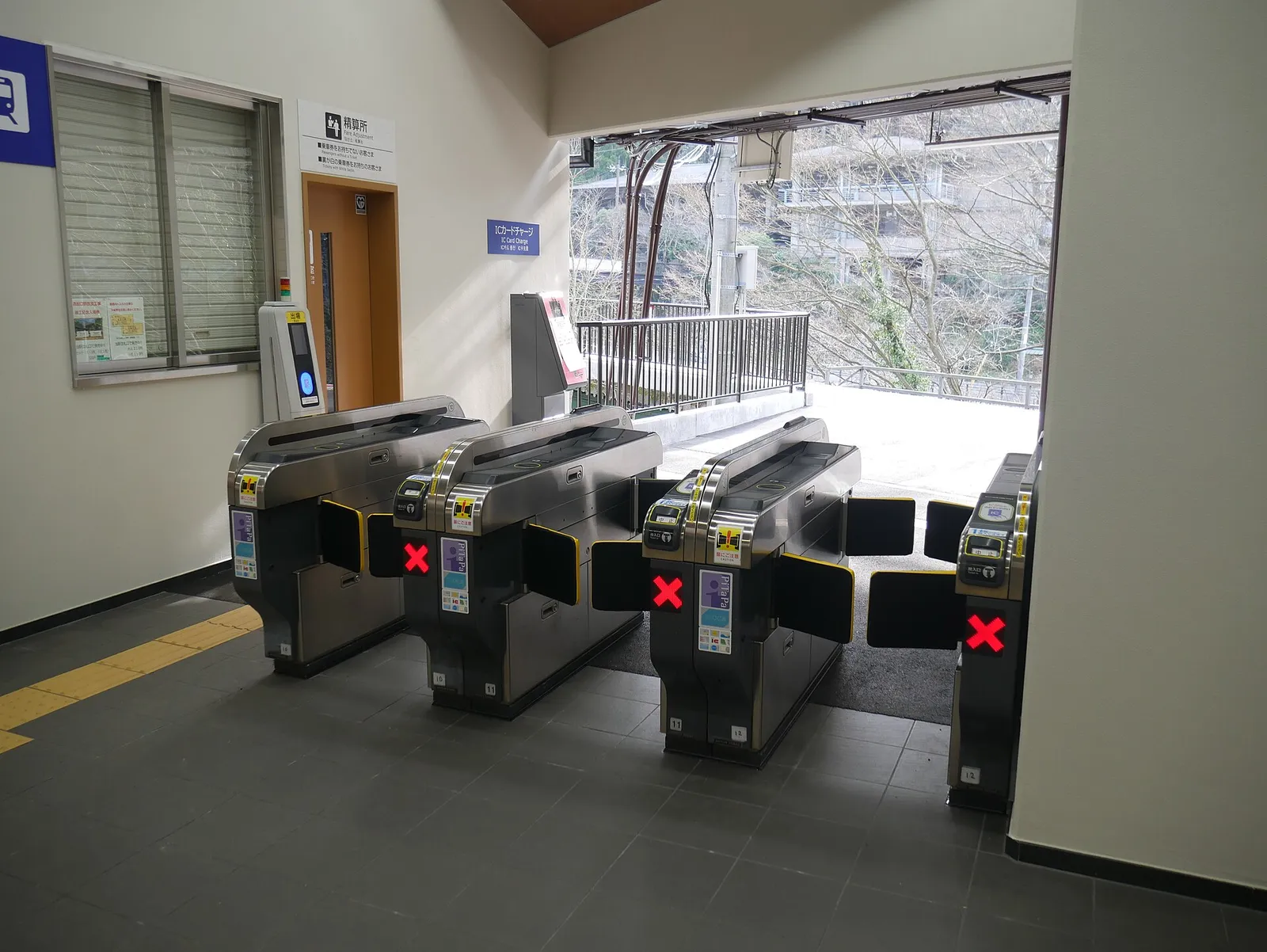
At the station, the flow is: insert/tap through the regular gate (or the Shinkansen gate for bullet trains), follow signs to your platform, then find your car number — floor markings beside the train queue lanes are numbered by car, so stand at your number and board when the train stops. Reserved tickets show car and seat; unreserved means cars 1–3, first come first served. If a train company app is beyond you on day one, tickets at the machine take three minutes.
Oversized luggage: on the Tokaido/Sanyo/Kyushu Shinkansen, bags over 160 cm total dimensions require a seat with a luggage area and a ¥1,000 fee — book it on smartEX or at the machine. Between 120 and 160 cm bring it on free. This fee is not covered by the Japan Rail Pass, so pass holders still pay it.
For the pass-versus-tickets decision on these fares, see our JR Pass guide.
IC Cards in 2026: Which One to Get
An IC card (Suica, Pasmo, Icoca and seven siblings, all interchangeable) is a tap-to-pay transit card. It gives no discount over paper tickets — it is pure convenience, and it also pays at convenience stores, many restaurants, vending machines and coin lockers nationwide. Your realistic options as a visitor, as of October 2026:
| Option | Deposit | Validity | Best for |
|---|---|---|---|
| Suica/Pasmo/Icoca in Apple Pay | none | until you delete it | iPhone owners — set up at home |
| Welcome Suica Mobile app (iPhone) | none | 180 days | iPhone owners wanting a tourist card without Apple Pay fiddling |
| Physical Welcome Suica | none | 28 days | arrivals without iPhones; sold at limited airport/station counters |
| Regular Suica/Pasmo/Icoca card | ¥500 (refundable) | 10 years | longer stays, repeat visitors |
The setup, in order of preference:
- iPhone 8 or later: add Suica to Apple Pay (Wallet app → plus button → select Suica under transit cards). Do this before you fly — it takes two minutes. In Japan, note that some foreign-issued credit cards cannot top up a Suica in-app; if yours fails, top up with cash at any station machine or convenience store, which always works.
- Welcome Suica Mobile app (App Store, free): a tourist-only digital card, valid 180 days, no deposit and no refund process. Slightly more app clutter, slightly less friction than Apple Pay if your card balks.
- Physical Welcome Suica at the airport: still issued as of October 2026, but only at limited JR East Travel Service Center locations (Narita and Haneda airports, plus a few major stations) — valid 28 days, no deposit, leftover balance is not refundable.
- Regular card from any station machine: ¥500 refundable deposit plus an initial charge (typically ¥1,500). Choose this for stays beyond a month; return it at a JR East counter at the end to reclaim the deposit (a ¥220 handling fee applies if a balance remains).
Skip Android for now: Mobile Suica and its siblings require Japanese-model hardware (FeliCa/Osaifu Keitai), Japanese-language apps and often a Japanese card — effectively unusable for visitors, though Samsung has announced global Suica support for new phones from the first half of 2027.
What IC Cards Can and Cannot Do
They can, gloriously:
- Ride virtually every train, subway, tram and city bus in Tokyo, Osaka, Kyoto, Nagoya, Fukuoka and most other cities — one card, whole country.
- Pay at convenience stores, plenty of chain restaurants, vending machines, coin lockers and shops with the IC mark (up to ¥20,000 stored).
- Skip ticket machines entirely — tap in, tap out, the fare deducts automatically. In Tokyo, IC fares are even a few yen cheaper than paper because there is no rounding.
They cannot:
- Travel long distances between IC areas. A Suica cannot tap you from Tokyo to Kyoto, or Tokyo to Sendai — the fare gates reject out-of-area journeys. For intercity Shinkansen you need a ticket, smartEX with your registered card, or a pass. (Registered-card smartEX rides charge your credit card, not the Suica balance.)
- Ride Nozomi on a pass without the supplement — see the JR Pass guide for amounts.
- Cover private railways in a few tourist pockets (e.g., the Hakone Tozan line inside Hakone, Tobu trains to Nikko). Those take cash, their own passes, or in many cases the same IC card for the non-JR portion — check before you board.
Losing your balance at the end of a trip is normal: spend it down at the airport convenience store. If you spot a stranger looking confused at a machine, our printable train check card says 「この電車は〇〇に行きますか?」— “Does this train go to XX?” — in large type you can show anyone.
Tokyo Day Passes: When to Skip the IC Card
Tokyo’s subway network is where a day pass occasionally beats tap-to-pay. The Tokyo Subway Ticket covers all Tokyo Metro and Toei subway lines (not JR): ¥1,000 for 24 hours, ¥1,500 for 48, ¥2,000 for 72, as of October 2026. Foreign tourists can buy it as a QR ticket online and at the airports; the rule of thumb is you need about four subway rides per day to break even — so it rewards packed museum-and-neighborhood days and loses on lazy ones with JR or walking in between. Regular one-day passes sold to everyone at subway stations (¥1,100 for Metro+Toei) only pay off on extreme days.
A worked example of mixing systems: arrive at Kansai Airport, take the Haruka limited express to Osaka Station (¥2,910 reserved, covered by an Icoca-region pass or paid), tap Icoca around Osaka’s metro, buy a Hikari ticket (or pass) to Tokyo, then tap Suica around Tokyo. The IC card handles the cities; tickets handle the distances.
Common Mistakes
- Trying to tap from Tokyo to Kyoto. Bare IC cards do not work on intercity Shinkansen across regions. Buy a ticket, use smartEX, or carry a pass — this is the single most common gate rejection.
- Setting up Apple Pay Suica at the airport on hotel Wi-Fi. Do it at home; the Wallet card add occasionally needs a retry and you want your own data plan. (Our connectivity guide covers eSIMs.)
- Topping up ¥10,000 on day one. City fares run ¥150–260 a ride; ¥2,000–3,000 on the card is plenty until the next machine. Balances are refundable only with fees (¥220) and effort.
- Assuming unreserved seats are always fine. On Golden Week, Obon, New Year and weekend mornings, unreserved cars fill at the platform. A reserved seat costs a few hundred yen more (Tokyo–Kyoto reserved is ¥13,850 vs ¥13,320 unreserved on Nozomi) — cheap insurance.
- Ignoring the oversized luggage rule. Bags over 160 cm on the Tokaido/Sanyo/Kyushu line need the ¥1,000 luggage seat, booked in advance — skiers and snowboarders, this means you.
- Queueing anywhere at the platform. Stand behind the numbered floor marks for your car, let people off first, then board. It is not politeness theater; it is how 1,300 people exchange places in 40 seconds.
- Buying a day pass for a day you will mostly walk or ride JR. The Subway Ticket needs four rides. Two shrine visits and a park stroll? Tap the IC card and stop doing math.
See it in motion
Some places earn a moving picture
Stills can't show how this place moves — the drift, the light show, the crowd flow. We picked a recent, high-quality walkthrough rather than a promotional cut.
10 Things You Must Know - Riding Japan’s Bullet Train
Kensho Quest · YouTube · plays on click
Embedded via YouTube's official player (privacy-enhanced mode). Video: 10 Things You Must Know - Riding Japan’s Bullet Train by Kensho Quest. Not affiliated with Japan Travel Navi; screened for quality and accuracy on 2026-10-06.
Sources & verification (8)
- https://www.japan-guide.com/e/e2359_003.html
- https://www.japan-guide.com/e/e2359.html
- https://www.japan-guide.com/e/e2018.html
- https://www.japan-guide.com/e/e2017.html
- https://www.japan-guide.com/e/e2363.html
- https://smart-ex.jp/en/
- https://www.sevenbank.co.jp/intlcard/card.html
- https://transit.yahoo.co.jp/search/result?from=%E6%9D%B1%E4%BA%AC&to=%E4%BA%AC%E9%83%BD&expkind=2