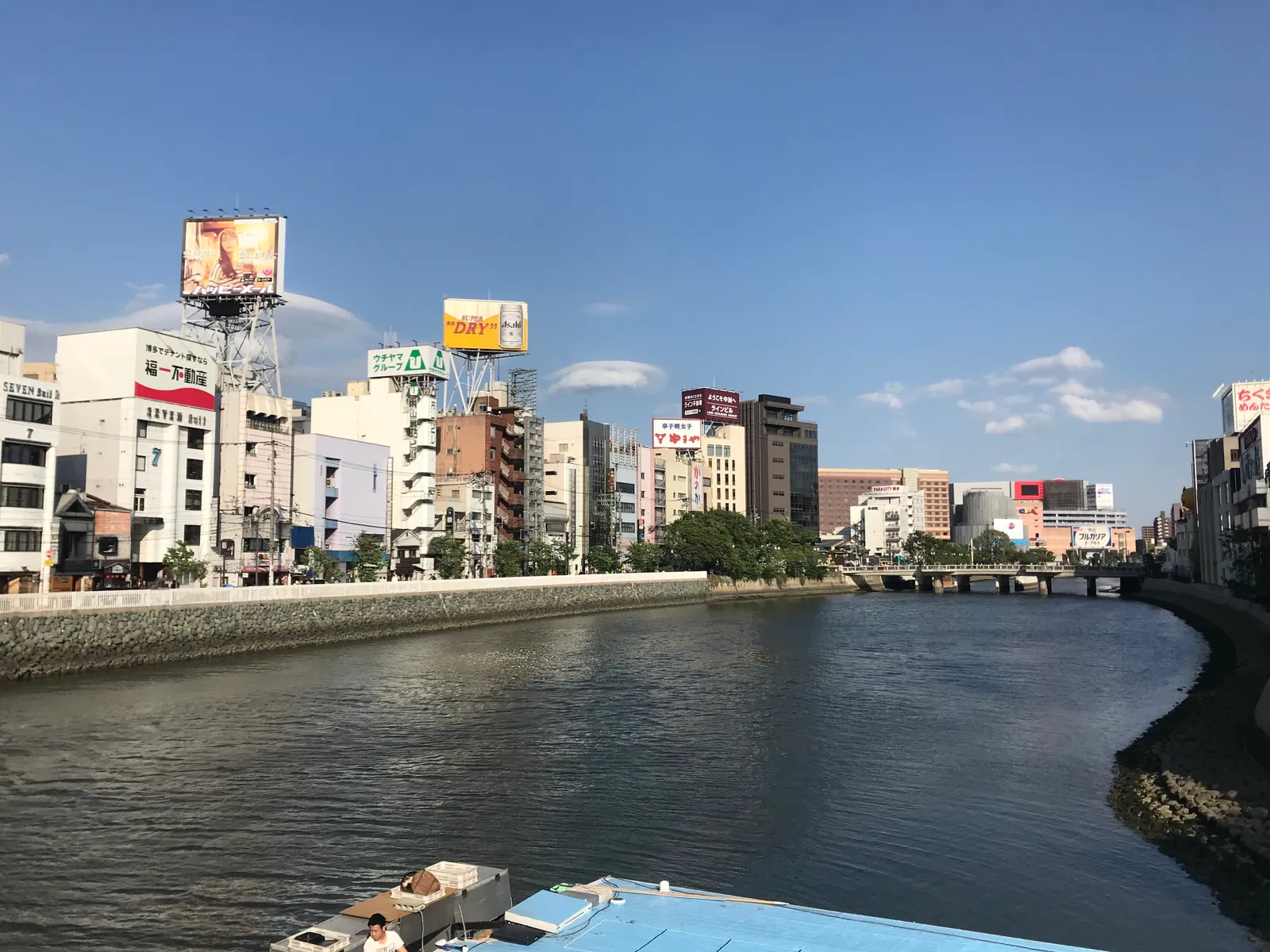
Fukuoka is Japan's friendliest big city and its best-kept food secret. The airport sits ten minutes from the downtown core by subway, the shinkansen runs straight into Hakata Station, and within an hour of landing you can be seated at a yatai - a riverside food stall - with a bowl of the tonkotsu ramen this city invented. Fukuoka (the old castle town) and Hakata (the old port) merged into one city in 1889, and both names survive in the geography. The essentials: about twenty yatai stalls on Nakasu island, the plum-shaded Dazaifu Tenmangu shrine half an hour south, Ohori Park's two-kilometer moat-loop, the Canal City shopping complex, and a 41-meter bronze reclining Buddha a short train ride away. Best for first-timers who want a big-city-plus-beach itinerary, eaters, and anyone combining Japan with Korea - Busan is three hours away by jetfoil.
Top sights at a glance
No. 1
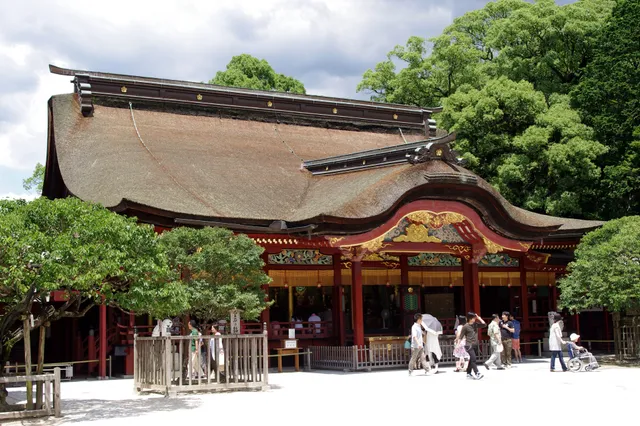
Dazaifu Tenmangu
The head shrine of Japan's cult of Tenjin, the deity of learning, built over the grave of the exiled ninth-century scholar Sugawara Michizane. Students come by the busload to pray for exam luck beneath 6,000 plum trees - one of which, the 'flying plum' beside the main hall, is said to have followed Michizane from Kyoto. The approach is a stroll across arched bridges spanning a heart-shaped pond, past plum-shaded grounds that bloom late February to mid-March. The 1591 main hall finished a full renovation in May 2026.
Good to know · Grounds are free and never close; allow two to three hours. From Tenjin, take the Nishitetsu train toward Omuta, transfer at Futsukaichi to the Dazaifu line - 25-40 minutes, 480 yen total. Go on a weekday morning; the omikuji fortunes and goshuin shrine stamps are worth the queue, and the Kyushu National Museum next door costs 700 yen.
No. 2
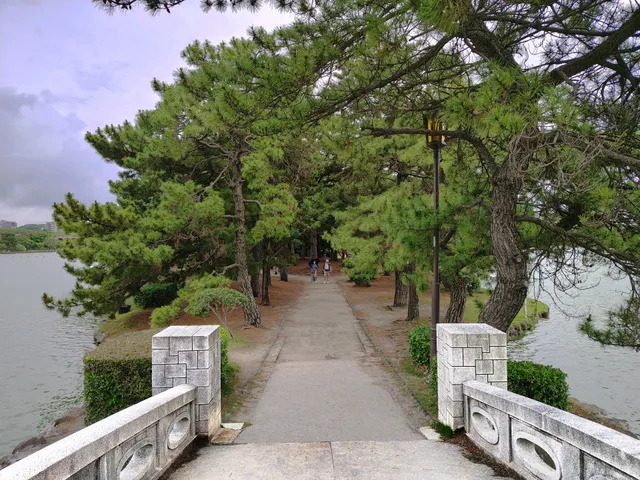
Ohori Park
A large pond that was the outer moat of Fukuoka Castle, turned in the 1920s into a public park modeled loosely on Hangzhou's West Lake. A two-kilometer path circuits the water past three islands joined by stone bridges, and it is the city's shared backyard: joggers at dawn, grandparents and strollers all day, cherry-blossom crowds in early April. Next door stand the Fukuoka Castle ruins, sakura viewing spot of the Kuroda lords, and the Fukuoka Art Museum.
Good to know · Free, always open. The lakeside Japanese Garden charges 250 yen (closed Mondays and December 29-January 3). Get there via Ohori Koen subway station, ten minutes and 260 yen from Hakata. Combine with the castle ruins and Maizuru Park for a half-day; rent a pedal boat or simply jog the loop counterclockwise with the locals.
No. 3
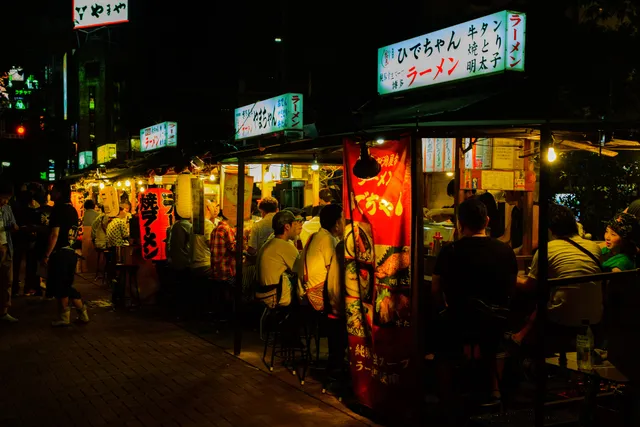
Nakasu Yatai Stalls
Fukuoka's open-air food stalls - a surviving tradition that most Japanese cities regulated away decades ago. Around twenty yatai line the Naka River's edge on Nakasu island, each a tiny illuminated kitchen seating about seven or eight people elbow to elbow. The default order is Hakata tonkotsu ramen - milky pork-bone broth, thin noodles - alongside yakitori and oden, with beer or shochu. It is the single best way to meet locals in Japan, because at a yatai there is no escaping them.
Good to know · Stalls open around 18:00 and close near 2:00, weather permitting; many take one weekday off, often Sunday. Expect a wait on Friday and Saturday nights - one group per seat, so turn over is fast. Cash is safest, and one drink plus one dish per person is the polite minimum. Take the subway to Kushida Shrine station, one stop from Hakata, or walk 10-15 minutes from Tenjin.
No. 4
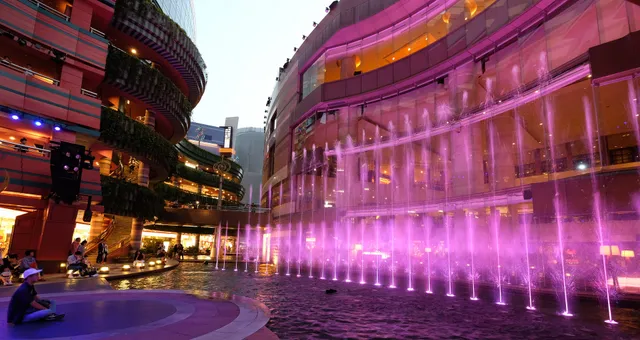
Canal City Hakata
A vast, red-brick-and-glass 'city within the city' wrapped around an artificial canal: roughly 250 shops, cafes, and restaurants, plus theaters, cinemas, and a hotel, a ten-minute walk from Hakata Station. The theatrical fountain show at the canal's center is the free attraction - water choreographed to music every 30 minutes - and the fifth-floor Ramen Stadium gathers eight famous ramen shops from all over Japan under one roof for a choose-your-own-pilgrimage lunch.
Good to know · Open 10:00-21:00, restaurants to 23:00, no closing days; fountain shows run every 30 minutes from 10:00 to 22:00. Do your gift shopping here (basement food hall for mentaiko), then eat ramen on the fifth floor at an off-peak hour - 11:30 or after 14:00 - to skip lines. Walk from Hakata Station in 15 minutes or take the subway one stop to Kushida Shrine.
No. 5
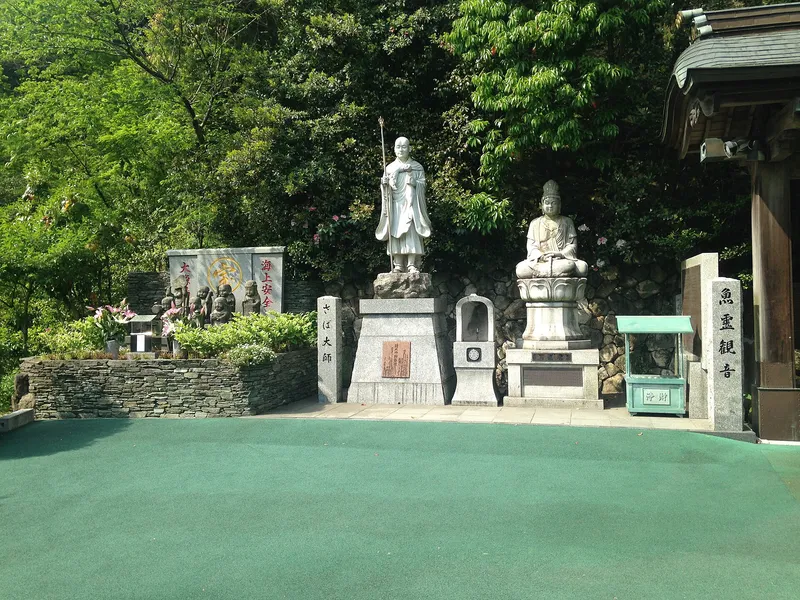
Nanzoin Temple
A Soto Zen temple in the wooded hills of Sasaguri, half an hour west of downtown, guarded by a reclining bronze Buddha some 41 meters long - one of the largest bronze reclining Buddhas in the world, completed in 1995. The scale of the statue against the trees stops conversation, and the temple complex around it, headquarters of the Sasaguri 88-temple pilgrimage, adds halls, moss steps, and a mountain stillness that feels far from the tenth-largest city in Japan. Free to visit.
Good to know · Admission is free, and the grounds welcome visitors daily; modest dress applies, as this is an active temple with cremation memorials - photograph respectfully. From Hakata Station take the JR Fukuhoku-Yuryo (Sasaguri) Line about 25 minutes to Nanzoin-mae; the temple gate is a few minutes' walk from the platform. Go on a weekday morning, and combine with Dazaifu or a morning at Ohori Park.
See it in motion
Some places earn a moving picture
Stills can't show how this place moves — the drift, the light show, the crowd flow. We picked a recent, high-quality walkthrough rather than a promotional cut.
🇯🇵 Japan Walking Tour | Day and Night Walk Streets of Fukuoka Japan City | 4K HDR 60fps
World Wanderings: 4K Walking Tours · YouTube · plays on click
Embedded via YouTube's official player (privacy-enhanced mode). Video: 🇯🇵 Japan Walking Tour | Day and Night Walk Streets of Fukuoka Japan City | 4K HDR 60fps by World Wanderings: 4K Walking Tours. Not affiliated with Japan Travel Navi; screened for quality and accuracy on 2026-10-06.
Fukuoka is the city travelers recommend to other travelers. Japan’s sixth-largest metropolis and the capital of Kyushu is compact, cheap by Japanese standards, and organized around eating: it invented tonkotsu ramen, maintains the country’s best street-food stall culture, and treats dinner as a civic sport. The airport is five minutes from the downtown subway stops, the shinkansen lands you in the middle of the city, and the airport beach is, improbably, a real swimming beach. First-timers use it as a warm-up or a finale on the Osaka-Fukuoka corridor; the city repays a slower visit with one of Japan’s great half-day shrines, a riverside stall-and-beer evening, and the most relaxed big-city pace in the country.
A Bit of History
This coast has always faced outward. Hakata was a port when Kyoto was a village: Nara-period diplomats built a guesthouse here (the Korokan) for envoys from China and Korea, and when the Mongols invaded Japan twice in the thirteenth century, they chose this bay as their landing point. The defensive wall the samurai built along the shore, and the “divine wind” typhoons that wrecked the fleets, entered Japanese history as the origin of the word kamikaze.
The modern city is really two. Hakata, the merchant port, grew rich on trade with Asia; Fukuoka, the castle town, was founded in 1601 when the warlord Kuroda Nagamasa built his castle on the west bank. The two faced each other across a canal like rivals for three centuries - merchants versus samurai, each with its own dialect quirks and festivals - until the 1889 merger fused them into one city under the name Fukuoka. Hakata kept the railway station’s name and the airport code, which is why your train ticket says Hakata and your map says Fukuoka. Both halves burned in the 1944-45 air raids; almost everything postdates the rebuilding, which is why the city feels young.
Young it remains: Fukuoka has marketed itself for a decade as Japan’s startup city - national tax and visa programs for founders, coworking towers around Tenjin, the highest ratio of entrepreneurs per capita among big Japanese cities - and it has the youngest average age of any major Japanese city. Yet the traditions most worth seeing predate the towers: the Hakata Gion Yamakasa festival, in which seven neighborhoods race one-ton floats through the pre-dawn streets each July 15, has run for more than seven centuries, and the yatai stalls go back to the Edo period. Come during the first half of July if you can: kazariyama floats over ten meters tall decorate the city from July 1, and the race itself starts at 4:59 a.m.
Culture & Daily Life
The pace is the appeal. Fukuoka feels like a big town that happens to have 1.6 million people: subway rides rarely exceed 15 minutes, the two downtown cores (Hakata around the station, Tenjin three subway minutes west) are walkable into each other, and the whole center tilts toward the Naka River, where the yatai glow. Even rush hour is calmer than Tokyo’s.
Food organizes the day. Lunch is a bowl of Hakata tonkotsu ramen - the rich, milky pork-bone broth locals eat at any hour, in shops so specialized they ask your noodle-firmness preference (katame, hard, is the local order) and offer kaedama, a cheap second helping of noodles dropped into your remaining broth, for a couple hundred yen. Dinner might be motsunabe, the local beef-offal hotpot invented for postwar cheap protein, or yatai-hopping on the river. Show 「替え玉をお願いします」 when you want that noodle refill - it works in every ramen counter in the city.
A few practical notes. IC cards are universal: the local Sugoca, Hayakaken, and Nimaca all work everywhere, and so do Suica, ICOCA, and other national cards, on trains, subways, buses, and even the ferry to Nokonoshima. English is more common than in most of Japan thanks to the port and university - the city’s tourism info counters at Hakata Station are genuinely useful. And the baseball team, the SoftBank Hawks, plays in a domed stadium next to the airport line; a summer evening game with the organized cheering sections is one of Japan’s great cheap spectacles.
The calendar’s big moments: cherry blossoms ring Ohori Park in late March to early April, the Yamakasa festival builds through early July, and autumn brings the best yatai weather.
Nature & Day Trips
The essential half-day is Dazaifu, thirty minutes south by private railway (covered below as a sight) - a shrine town of plum trees, covered arcades, and the excellent Kyushu National Museum. Pair it in one day with Yanagawa, an old canal town another twenty minutes down the line, where punts pole you past weeping willows and samurai-era storehouses.
West of the city, the Itoshima Peninsula is where Fukuoka goes on weekends: a serrated coastline of coves, oyster shacks (in winter), bakeries and beach cafes in old houses, and the photogenic twin torii of Sakurai Utsumi rising from the sea. It is 40-60 minutes by car or direct bus, best as a slow half-day. For a quicker escape, ferries cross to Nokonoshima, an island ten minutes off Meinohama with a flower-park hillside that flames with rapeseed in spring and cosmos in autumn, plus small beaches.
North along the bay, Uminonakamichi is a long sandbar of seaside park, cycling paths, and a small aquarium - flattest family bike ride in the region. And because Fukuoka is Kyushu’s rail hub, the bigger day trips fan out: Kitakyushu’s retro Mojiko port in under an hour, Nagasaki in about two, and the onsen towns of Yufuin and Beppu in about two on the pleasant Yufuin no Mori limited express, for which you should reserve the green-car wood-paneled cars well ahead.
Food & Drink
Start with the ramen, because Fukuoka did. Tonkotsu here means a broth simmered from pork bones for the better part of a day until it is opaque and faintly sweet, served with thin, fast-cooking noodles - hence kaedama, the noodle refill, since the noodles go soft in minutes. A full bowl runs 700-1,000 yen; order katame noodles, drop the pickled red ginger and sesame on top, and consider the chashu-topped version only after your first plain bowl. The Ramen Stadium on Canal City’s fifth floor offers a greatest-hits tour of regional styles beyond the local one.
Mentaiko - pollack roe spiced in the Korean style and eaten raw over rice - is the other edible export; buy it vacuum-packed in any basement food hall, kept chilled for travel. Motsunabe, the offal hotpot with cabbage and garlic chives, is the winter dinner (2,500-4,000 yen with drinks at a proper shop), and the city’s sushi and fish counters concentrate at Yanagibashi Rengo Market, “Hakata’s kitchen,” where a wandering breakfast of tuna and tamagoyaki runs 1,000-2,000 yen. Street-level happoshu and craft beer have come to the yatai; the local sake from the Itoshima and Chikugo regions is sweet-leaning and smooth. Budget 3,000-4,500 yen for a full izakaya dinner; a ramen-and-yatai day can come in under 3,000 yen without trying.
Two sweets to know: umegae mochi, a grilled rice cake with red bean, sold along Dazaifu’s approach street and worth the queue at the original shops; and Hakata torimon, the soft sweet-potato pastry that is the standard omiyage box.
Top Sights
Dazaifu Tenmangu
Sugawara no Michizane was the most brilliant scholar of his age, exiled from Kyoto on false charges in 901, dead in Dazaifu two years later, and deified afterward as Tenjin, the god of learning - which is why Japan’s students have been praying to him for a millennium. The shrine stands over his grave: a vermilion complex reached across two arched bridges spanning a pond shaped like the character for “heart,” with 6,000 plum trees on the grounds. The “flying plum” beside the main hall is said to have flown from Kyoto overnight to follow its master into exile; it blooms first, usually late February.
The 1591 main hall completed a three-year renovation in May 2026, so the paint is fresh. Grounds are free and never close; two to three hours covers the shrine, the approach’s plum-themed snack street, and your choice of museums (the shrine’s treasure museum is 500 yen; the Kyushu National Museum, a bold blue wave of a building at the end of the approach, is 700 yen, or 1,000 yen bundled with both shrine museums). Getting there is the easy part: Nishitetsu train from Tenjin, transfer at Futsukaichi to the Dazaifu line, 25-40 minutes and 480 yen each way - there are no direct trains, so let the app route you. Weekday mornings are quiet; exam season (January-March) brings long ema plaques dense with wishes.
Ohori Park
Fukuoka’s castle needed a lot of water, and the giant pond at Ohori - the name literally means “moat” - is what remains of its outer defense, landscaped into a park in the 1920s after a Chinese West Lake aesthetic. Today the two-kilometer loop is the city’s treadmill: runners at 6 a.m., power-walkers all day, and everyone else out on the rental swan boats. Three islands string across the water on stone bridges, each with a teahouse pavilion view.
Enter from Ohori Koen subway station (ten minutes, 260 yen from Hakata) and walk the loop clockwise for the castle-side views. The Japanese Garden on the southeast corner (250 yen, closed Mondays and the New Year break; 9:00-17:00, to 18:00 May-September) condenses a stroll garden into a hectare of streams and maples - worth the small fee and 30 quiet minutes. Then walk five minutes to the Fukuoka Castle ruins in Maizuru Park: mostly stone walls and turret foundations now, but the view corridors and the February plum grove make it clear why the Kuroda chose this ground. Pair the whole ensemble with the Fukuoka Art Museum (200 yen) on a rainy day.
Nakasu Yatai Stalls
The yatai is Fukuoka’s living room, office, and after-party. About twenty stalls line the Naka River at the southern tip of Nakasu island - red lanterns, plastic stools, seven or eight seats under one tarp - with dozens more scattered around Tenjin and the station. Each stall has a specialty and a regular crowd; the classic order is Hakata ramen or yakitori with a beer, and the actual meal is conversation, because at a yatai the stranger beside you is your dinner companion whether you planned it or not.
Rules that keep it working: go before 20:00 or after 22:00 to dodge the longest waits (stalls open around 18:00, close around 2:00, and many rest one day a week, often Sunday); one drink and one dish minimum per person; cash in small bills; no lingering after paying when a line has formed. Heavy rain closes the stalls. Getting there: one subway stop from Hakata to Kushida Shrine station (210 yen), and the stalls are at the river; from Tenjin it is a ten-minute walk east. If a stall is full, put your name up with a gesture and wait riverside - turnover is faster than any restaurant.
Canal City Hakata
Call it a mall and miss the point: Canal City is a five-story entertainment complex wrapped around an artificial canal, built in 1996 as the flagship of downtown Fukuoka’s revival, with roughly 250 shops and restaurants, two performance theaters, a cinema, and a hotel. For travelers it solves three problems in one stop. Shopping - the basement food hall is the best one-stop mentaiko and Hakata-sweets run in the city. Rainy-day time-killing, with the fountain shows every 30 minutes from 10:00 to 22:00 and free stage events. And lunch: the fifth-floor Ramen Stadium gathers eight ramen shops spanning Japan’s regional styles - Hakata tonkotsu, Sapporo miso, Tokyo shoyu - in one corridor, so a group can each have their region and eat together anyway.
Hours are 10:00-21:00 for shops (restaurants to 23:00), no closing days. From Hakata Station it is a flat 15-minute walk down Chikuzen street; from Tenjin, 20 minutes, or one subway stop to Kushida Shrine and five minutes’ walk. Walk back along the river at dusk - Canal City to the Nakasu yatai is ten minutes on foot.
Nanzoin Temple
Half an hour from Japan’s tenth-largest city stands one of its largest Buddhas - a bronze reclining figure about 41 meters long, resting its head on one hand, completed in 1995 as the centerpiece of this Soto Zen temple in the Sasaguri hills. The scale does not register until you are under the sole of one foot: the statue lies along a forested slope like a ship in drydock. Nanzoin is also the anchor of the Sasaguri 88-temple pilgrimage, a miniature Shikoku circuit locals walk in running shoes on weekends, so the paths have a low steady traffic of pilgrims in white.
Admission is free. Take the JR Fukuhoku-Yuryo (Sasaguri) Line from Hakata about 25 minutes to Nanzoin-mae - one of Japan’s great station-to-sight walks, five minutes door to door - and note the temple honors quiet and modest dress because its grounds hold cremation memorials: this is a working temple, not a photo set, and the signs (in several languages) about restricted areas are serious. A couple of hours covers the reclining Buddha, the main halls, and the moss-covered slopes; combine with Dazaifu in one day only if you start early, or just come here for a half-day of the calm the city does not have.
Getting There & Around
Fukuoka Airport is the reason this city is an easy add-on: the subway connects it to Hakata Station in five minutes and Tenjin in about eleven, with trains every few minutes (roughly 260 yen) - you can be at your hotel within 30 minutes of wheels-down. The airport handles domestic trunk routes plus Seoul, Shanghai, and Taipei. By rail, the Nozomi shinkansen runs Hakata-Tokyo in about five hours (around 23,000 yen one way; Japan Rail Pass holders ride Hikari/Sakura with a transfer), and Osaka in about 2.5 hours; the JR Pass covers the Hikari/Sakura routing without supplements.
Busan, South Korea is three hours away by high-speed jetfoil - the quickest country-hop in Asia, bookable through JR Kyushu’s Beetle service - if your itinerary wants two countries. In town, the two subway lines (Airport/Kuko Line and Hakozaki Line, plus the Nanakuma tram-subway to Tenjin south) cover everything tourist-relevant; a 1-day subway pass is 640 yen, and the Fukuoka Tourist City Pass (2,500 yen; 2,800 yen including the Nishitetsu line to Dazaifu) bundles subway, bus, and Nishitetsu trains - buy the 2,800-yen version on Dazaifu days. All national IC cards work everywhere. Hakata to Tenjin is a 15-minute walk if the weather is kind; taxis are metered and plentiful.
Where to Stay
Stay near Hakata Station for logistics: the shinkansen, the airport subway, the Dazaifu express buses, and the department-store basements are all in one complex, and the yatai are a 15-minute walk. Best for one-night stops and anyone with early trains.
Tenjin, three subway minutes west, is the shopping-and-nightlife pick: department stores, small bars, indie boutiques, and the student energy of a university district, with the yatai and Nakasu a short walk east. This is where you want your evenings.
Nakasu itself, the narrow island between the two, holds business towers, riverside hotels, and the yatai literally downstairs - the most atmospheric convenience, at the price of some late-night noise. All three areas are safe, walkable, and cheap by Japanese big-city standards; book two months ahead only for early July, when the Yamakasa festival fills the city.
Sources & verification (9)
- https://www.japan-guide.com/e/e2161.html
- https://www.japan-guide.com/e/e4800.html
- https://www.japan-guide.com/e/e4802.html
- https://www.japan-guide.com/e/e4803.html
- https://www.japan-guide.com/e/e4805.html
- https://www.japan-guide.com/e/e4808.html
- https://www.japan-guide.com/e/e4851.html
- https://www.japan-guide.com/e/e4854.html
- https://en.wikipedia.org/wiki/Nanz%C5%8D-in