Japanese Etiquette and Manners: What Actually Matters in 2026
Japanese manners have a fearsome reputation, but the rules that actually matter to visitors fit on one page — and most concern trains, shoes and trash rather than elaborate ritual. This guide covers shoe etiquette and the slipper system, why your phone stays silent on trains, which side of the escalator to stand on in Tokyo versus Osaka, how to handle trash in a country with few public bins, chopstick basics, the full shrine-visit ritual including the two-bows-two-claps prayer, and why tipping does the opposite of what you intend. Learn these nine things and you will be more polite than 95 percent of visitors.
The short version
- Shoes come off at the entrance of homes, temples, ryokan and many restaurants — follow the shoe line, and never step on tatami with anything on your feet
- On trains: phone on silent (manner mode), no calls, keep conversations low, and give up priority seats
- Stand on the left on escalators in Tokyo and most of Japan, on the right in Osaka — when in doubt, mirror the locals
- Public trash cans are scarce; carry a small bag and dispose of trash at your hotel or a convenience store
- At shrines: rinse hands and mouth at the font, then offer a coin, bow twice, clap twice, pray, bow once — and never tip anyone, anywhere
Relax first: Japan is a forgiving host. Nobody expects fluency in unspoken rules, and locals will not correct a foreigner’s bow. But a handful of manners are genuinely noticed — on trains, at entrances and around food — because they affect the people physically around you. Master the ones below and the rest is goodwill.
Shoes, Slippers and Tatami
The shoe system has three layers, and getting them wrong in order is the classic visitor stumble. At the entrance (genkan) of any home, ryokan, temple hall, fitting room and many traditional restaurants, shoes come off before you step up into the interior — there is usually a shoe rack or a step that makes the boundary obvious. Indoor slippers are usually provided; put them on after removing your shoes.
Two sub-rules finish the picture: take the slippers off before stepping on tatami mats (bare feet or socks only — the straw is delicate), and swap them for the dedicated toilet slippers when entering a bathroom, leaving the indoor pair at the door. Wandering back into a hallway in toilet slippers is the one mistake Japanese comedy has mined for decades. If you see a raised floor and a shoe line, you have your answer: shoes off.
Trains: Quiet Is the Rule
The expectations on public transport are specific and unforgiving: phones on silent (what the announcements call “manner mode”), no phone calls while riding trains and buses, headphones at a volume only you can hear, and conversations kept low. Priority seats — marked at the end of each car — go first to elderly, pregnant or disabled passengers; if the car is crowded, stand. Everything about queueing happens before boarding: stand behind the platform floor markings aligned to the train doors, let everyone off, then board in order. Nobody shoves; the system only works because everyone follows it.
Eating on local commuter trains is frowned upon (long-distance trains are a different culture — bento on a Shinkansen is a pleasure, not an offense). For everything about tickets and IC cards, see our trains guide.
Escalators, Queues and Trash
On escalators, the custom is to stand on one side and leave the other for walkers: the left in Tokyo and most of Japan, the right in Osaka. It is not enforced by anything but stares, and the stares are mild — but mirroring the person in front of you takes zero effort. (Some stations now ask everyone to stand on both sides for safety; if a poster says so, stand.)
Queueing, meanwhile, is close to a national sport. There is a line for the platform door, a line for the taxi stand, a line for the ramen counter, a line for the vending machine during intermission. Find the end of it, stand in it, and trust the process — lines in Japan move and nobody tolerates cutting. When in doubt about whether a line exists: it does. Join it.
And then there is trash: public bins are genuinely scarce — removed years ago for security and never really returned — so the daily reality is that you carry yours. Keep a small plastic bag or a zip pocket in your daypack for wrappers and bottles, and dispose of things at your hotel room’s bin or at a convenience store (bins inside, near the register or door, ideally right after buying something there). Street littering is both rare and socially expensive; recycling separation matters mainly at hotels and homes, and “carry it until you bin it properly” covers a visitor’s obligations. Smoking is confined to designated outdoor smoking areas, and tossing a butt on the pavement can earn a fine.
Chopsticks and Table Manners
Dining has a short list of hard rules and a long list of optional grace notes. The hard ones concern chopsticks: never stand them upright in a bowl of rice (it mirrors funeral offerings) and never pass food from your chopsticks to someone else’s chopsticks (same funeral association). Rest them across the dish or on a chopstick rest between bites; do not spear food or point with them. Beyond that: say “itadakimasu” before eating and “gochisosama deshita” after; slurping noodles is not merely tolerated but normal; at sushi counters, dip the fish side — not the rice — in soy sauce, and don’t dissolve wasabi into it; blowing your nose loudly at the table is worse than stepping away. Asking for a doggy bag is generally not accepted — portions are sized to finish. For dietary restrictions and ordering help, our survival cards include a dietary card you can hand over in large-print Japanese.
Paying happens at the register, not the table, and cash or card goes on the small tray provided rather than hand to hand. Staff will greet you with an enthusiastic “irasshaimase” everywhere you go — a smile in return is optional and entirely enough; no response is expected. And the price is the price: see the no-tipping rule below.
Shrines: The Full Ritual
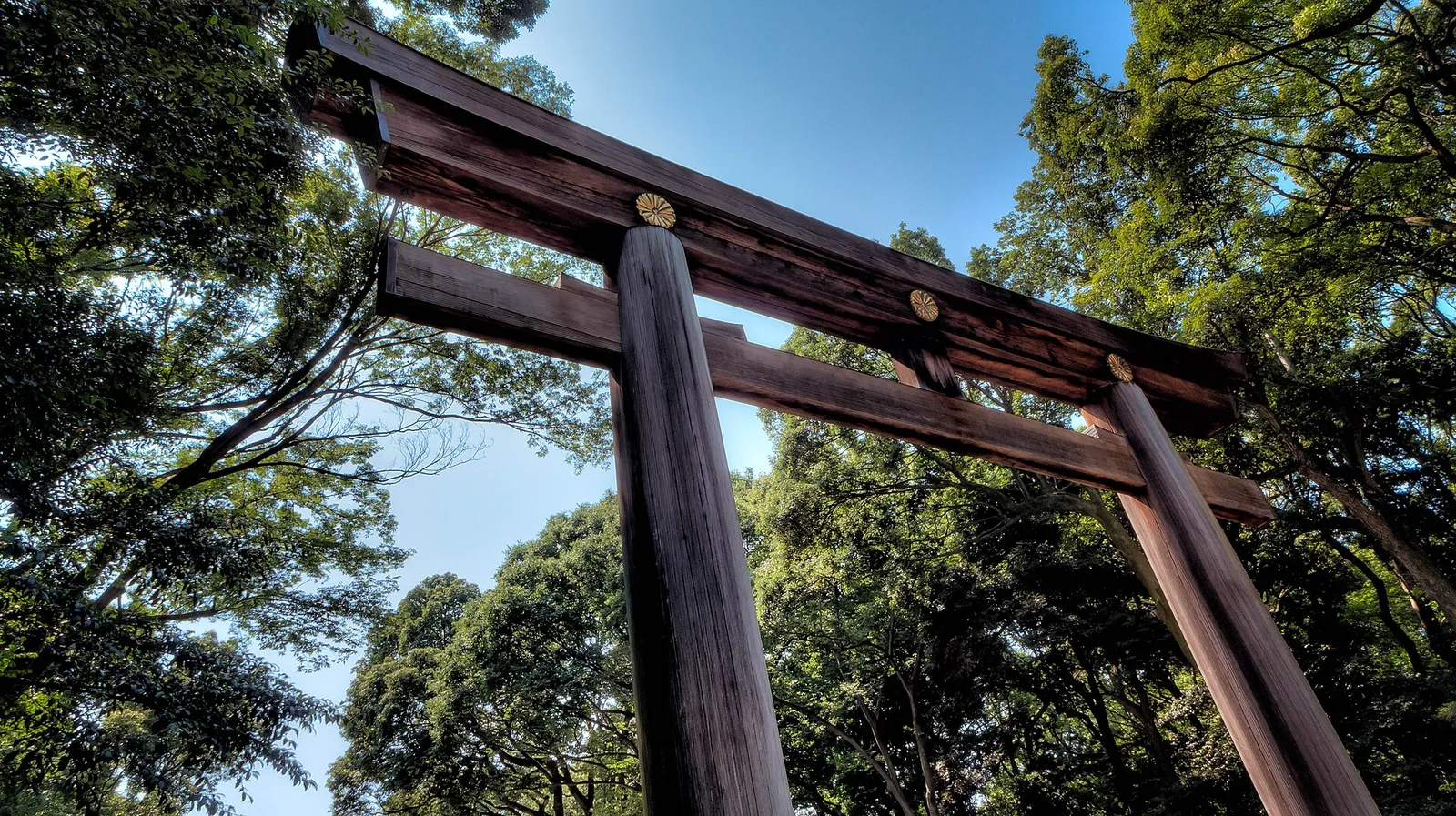
Shinto shrines (recognized by the torii gate) welcome respectful visitors, and the ritual is simple enough to do correctly on your first try:
- At the torii gate, bow lightly once as you enter — and again leaving.
- At the purification font (temizuya), rinse first: hold the ladle in your right hand, pour water over your left hand, switch hands and rinse your right. Then pour a little into your cupped left hand, rinse your mouth and spit the water beside the fountain — never back into it, never directly from the ladle, and never swallow. Tip the ladle upright so the remaining water rinses the handle, and return it.
- At the offering hall, throw a coin into the box (¥5 is the lucky classic), bow twice, clap your hands twice, pray silently for a few seconds, then bow once more. If there is a bell rope, ring it first to greet the deity.
Photography is fine on shrine grounds but usually not inside the halls; wedding parties and ceremonies in progress deserve extra distance. Buddhist temples follow a looser version — a bow and a quiet moment suffice, and incense is offered at some. For where to go, start with our city guides.
Tattoos, Bodies and Tipping
Visible tattoos carry an old association with organized crime and can bar you from public baths, pools and gyms — policies are easing but far from universal, and small tattoos can often be covered with a patch. The full playbook (cover-up tape, tattoo-friendly facilities, private baths) is in our onsen guide. Pointing at people is rude; open-hand gestures are the polite alternative. Blowing your nose into a handkerchief in public is fine, honking into it at dinner is not — step outside. And masks: many locals wear them when sick; bring some and join the custom if you catch a cold mid-trip.
The one money-side rule that reverses everything you know: there is no tipping in Japan — not at restaurants, not in taxis, not for hotel staff, not for guides on standard tours. The billed amount is complete, and leaving extra cash creates confusion: staff may chase you down to return your “forgotten” money. Exceptional hospitality is thanked with words — 「ありがとうございます」with a bow — and the finest compliment of all is simply coming back. (The mechanics of paying, tax-free shopping included, live in our money guide.)
Common Mistakes
- Walking onto tatami in slippers — slippers come off at the tatami edge; socks or bare feet only.
- Taking a call on the train. Even a short one. Text, or step off at the next station’s platform.
- Standing on the wrong escalator side and rigidly holding it. Mirror the locals; nobody expects perfection, just awareness.
- Stuffing trash into a shrine’s offering box, a plant pot, or anywhere “discreet.” Carry it. Everyone can tell.
- Chopsticks upright in rice, or food passed tip-to-tip. Both are funeral imagery — the two hardest taboos at the table.
- Rinsing your mouth straight from the temizuya ladle. Use your cupped hand; the ladle never touches lips.
- Tipping out of gratitude. It confuses the transaction and obliges staff to correct you. Say thank you instead — or show 「ありがとうございます」 from our card set.
- Worrying about bowing depth and handshakes. A nod suffices for foreigners; a handshake will be offered when wanted. Your effort is the politeness.
See it in motion
Some places earn a moving picture
Stills can't show how this place moves — the drift, the light show, the crowd flow. We picked a recent, high-quality walkthrough rather than a promotional cut.
14 Japanese Manners Tourists Don’t Realize
Howzit Japan · YouTube · plays on click
Embedded via YouTube's official player (privacy-enhanced mode). Video: 14 Japanese Manners Tourists Don’t Realize by Howzit Japan. Not affiliated with Japan Travel Navi; screened for quality and accuracy on 2026-10-06.
Sources & verification (7)
- https://www.japan.travel/en/guide/understanding-and-mastering-japanese-manners-and-etiquette/
- https://www.japan.travel/en/guide/japanese-manners-dos-and-donts/
- https://www.japan.travel/en/faq/
- https://www.japan-guide.com/e/e2057.html
- https://www.japan-guide.com/e/e2450_how.html
- https://www.japan-guide.com/e/e2292_ryokan.html
- https://www.japan-guide.com/e/e2359_003.html