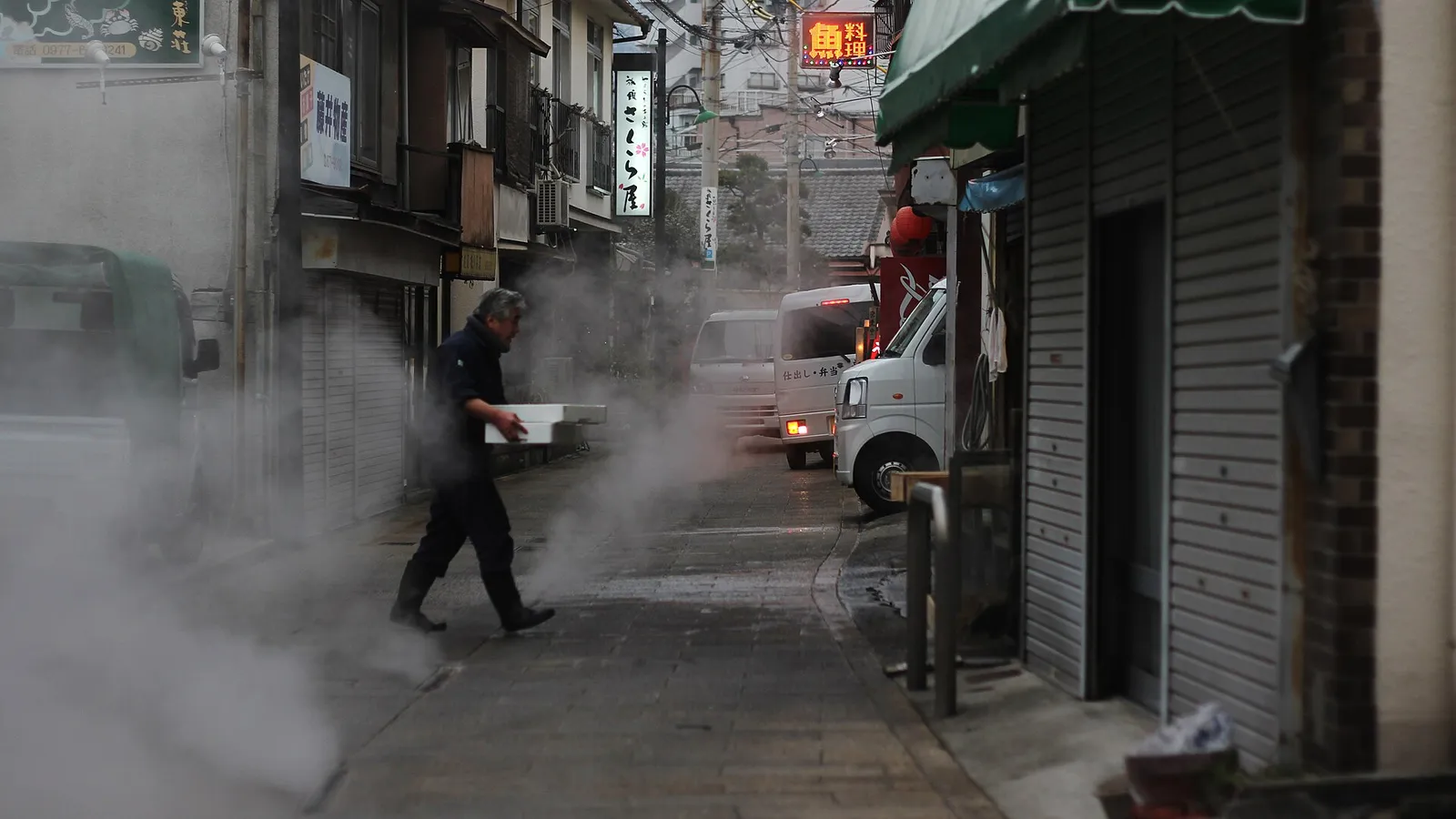
Beppu is the most productive hot spring city in Japan - eight spa districts pumping more water than any other resort town in the country, with the steam to prove it: columns of it rise from street grates, kitchen vents, and backyards across the whole bay. The signature experience is the Hells tour, seven ponds of boiling blue, blood-red, and bubbling mud too hot for bathing but built for looking. The rest is the deepest bath culture in Japan - steam baths, sand baths, mud baths, and public tubs in every neighborhood - plus steam-cooked dinners in Kannawa, yunohana powder huts in Myoban, and the inland resort village of Yufuin fifty minutes away. Best for onsen lovers, repeat visitors to Japan, and anyone touring Kyushu's volcanic spine.
Top sights at a glance
No. 1
The Hells of Beppu (Jigoku Meguri)
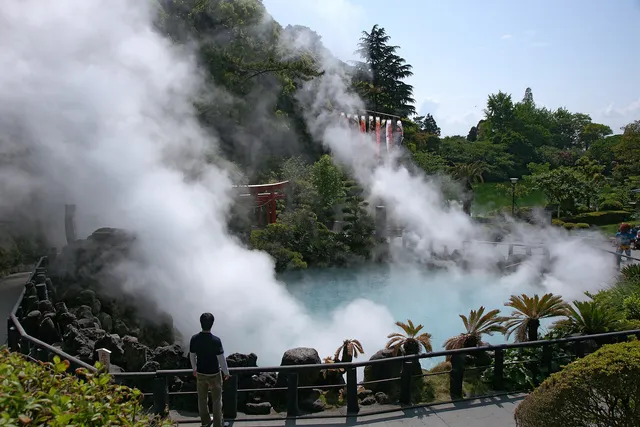
Seven hot ponds too hot to bathe in and too strange to skip, spread across the Kannawa and Shibaseki districts at the city's steamy northern end. Umi Jigoku is the star - a pond of transparent cobalt blue at 98 degrees Celsius, steaming against tropical planting - alongside the blood-red Chinoike, the grey mud bubbles of Oniishibozu, the geyser Tatsumaki, and three more. The ponds were the town's original tourist show in the Edo period, when a guided 'hell tour' was the standard entertainment, and the common ticket still strings them together in one circuit.
Good to know · The combined ticket is 2,400 yen (1,200 yen for children) and covers all seven, one entry each, valid the day of purchase plus the next; individually they run 450-500 yen. All open 8:00-17:00 year-round. Five hells sit walkably together in Kannawa; the red pond and geyser are in Shibaseki, five minutes onward by bus 16/16A. Two to three hours covers the circuit; buses 5 and 7 run there from Beppu Station in about 15 minutes.
No. 2
Myoban Yunohana District
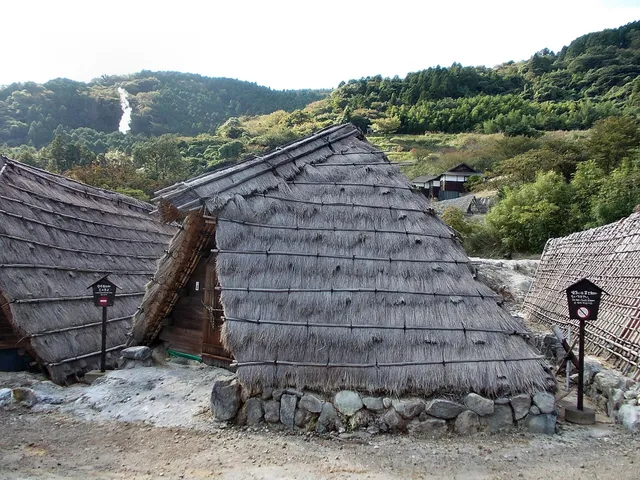
The hillside district above the city where Beppu's most unusual product is farmed: yunohana, a yellow-white mineral powder that condenses out of hot spring vapor on sloped straw gratings inside small thatched huts. The huts - low pyramids of thatch over steaming earth - have a shape unchanged in over three centuries, and the harvested powder is the traditional basis of bath salts sold across Japan. The air here smells of sulfur, the source of the district's milky, medicinal waters, and the small workshops let you watch the harvest.
Good to know · Walk the hill freely; the Myoban Yunosato complex (600 yen, 10:00-18:00, to 19:00 on weekends and holidays) adds sulfur baths, yunohana huts, and shops. The district is 15-20 minutes from Beppu Station by Kamenoi bus toward Myoban - ask for the Yunohana-goya stop. Buy yunohana salts here rather than in station souvenir shops; they are the local product at its source.
No. 3
Kannawa Steam District
Kannawa is where Beppu's steam becomes dinner. The district sits over such abundant vapor that restaurants, homes, and a public cooking center all vent it constantly, and the local tradition - jigoku-mushi, hell-steaming - turns the resource into a meal: you choose raw vegetables, eggs, seafood, and meat, put them in a bamboo steamer, and cook them over the natural steam yourself. The method is older than tourism here, begun by monks and patients using the vapor therapeutically; the food is simple and the point is the theater of cooking on a volcano.
Good to know · At the Jigokumushi Kobo center near the Kannawa bus terminal, steam chambers rent for 600 yen per 15 minutes (large) or 400 yen (small) plus ingredients from 150-3,000 yen; open 10:00-19:00 with last cooking start at 18:00, closed the third Wednesday monthly, as of October 2026. Bring nothing - aprons, tongs, and seasonings provided; no alcohol on the premises. Two free foot baths, one a steam bath, sit a few steps down the street.
No. 4
Yufuin Day Trip
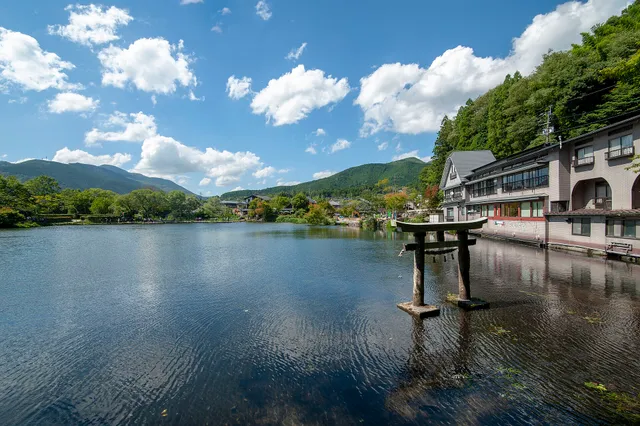
Fifty minutes inland by bus, Yufuin is Beppu's temperamental opposite: a rural onsen village of rice paddies and boutiques under the twin peaks of Mount Yufu, where the water is clear rather than sulfurous and the pace is strolling rather than soaking on a schedule. The walk from the station runs 1.5 kilometers along the main street of cafes, galleries, and craft shops to Kinrin Lake, a small lake that steams gently at its warm edge - the whole circuit takes a slow half day. Stay for an outdoor bath if time allows; several ryokan open theirs to day visitors.
Good to know · Kamenoi buses run the 50-minute ride roughly 1-2 times an hour at 1,100 yen one way; travelers without luggage should buy the Beppu bus pass wide enough to cover Yufuin (1,800 yen one day, 2,800 yen two). Going by train means transferring at Oita (about 80 minutes, 1,300 yen). Weekends bring tour crowds by late morning - arrive before 10:00 or after 15:00 for the village at its quietest. See our onsen guide for bath etiquette before a day-bath stop.
See it in motion
Some places earn a moving picture
Stills can't show how this place moves — the drift, the light show, the crowd flow. We picked a recent, high-quality walkthrough rather than a promotional cut.
Beppu Hells Walking Tour: Exploring Japan's Most Spectacular Hot Springs 4K
walking around · YouTube · plays on click
Embedded via YouTube's official player (privacy-enhanced mode). Video: Beppu Hells Walking Tour: Exploring Japan's Most Spectacular Hot Springs 4K by walking around. Not affiliated with Japan Travel Navi; screened for quality and accuracy on 2026-10-06.
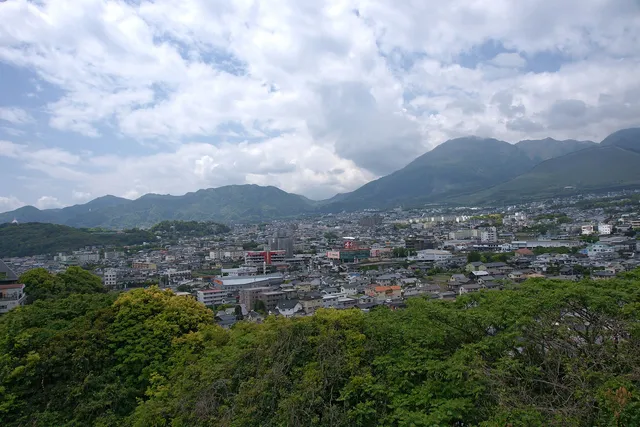
Some cities have a skyline; Beppu has a steam-line. The view arriving across the bay is of an ordinary mid-sized Japanese town wearing a permanent haze, vapor rising from thousands of wells, drains, and kitchen vents - the visible output of the most productive hot spring city in the country. Visitors have been coming to bathe in it for a thousand years and to gawk at its “hells” - ponds of boiling blue and blood-red water - since the Edo period, and both remain the program: soak your way through steam baths, sand baths, and neighborhood tubs, then walk the hell circuit with everyone else. Beppu anchors the onsen side of any Kyushu trip - it is the first major stop on our Kyushu onsen loop, an easy two hours from Fukuoka, and the springboard for Yufuin’s calmer pleasures.
A Bit of History
Beppu’s water has been on the record since Japan’s oldest provincial gazetteers, compiled in the eighth century, noted the remarkable hot springs and red-boiling pond of this coast. For most of the medieval and Edo periods this was a collection of rustic bathing villages - the “seven springs” of Beppu - where farmers, monks, and the sick came for toji, the traditional multi-week hot spring cure. The steam was therapy before it was tourism, and the village of Kannawa grew around vapor strong enough to cook with and sleep above in steam-heated floors.
The modern city is a creature of rails and promotion. The railway reached Beppu in the early 1910s, and the town’s boosters immediately began marketing it with a relentlessness that still shows: the seven springs were reorganized and expanded into the “eight springs” (Beppu Hatto) of today, the hell ponds were groomed into a formal circuit, and by the 1920s and 1930s Beppu was being advertised - to domestic bathers and, remarkably, to interwar international travelers - as the world’s greatest hot spring resort. The claim had a basis: the city sits on the flank of the Tsurumi volcanic group, and its wells and vents produce more hot spring water than any other resort in Japan.
War and aircraft ended the foreign trade, but the postwar domestic boom more than replaced it - Beppu became a mass-tourism monument of huge hotels and neon bathhouses, hosting millions of guests a year at its peak, the long-stay “bath soldiers” of company retreats and school trips among them. The bubble deflated in the 1990s, and the city spent the following decades rebuilding itself around a more mixed economy: the hells and the bath culture for visitors, Ritsumeikan Asia Pacific University - founded in 2000 with a student body drawn from dozens of countries - for a genuinely international small city, and a creative-tourism push that has put art festivals and renovated bathhouses among the steam. Today’s Beppu is quieter than its golden age and better for it: the hotels have softened, the baths have multiplied their types, and the steam still does the heavy lifting.
Culture & Daily Life
Daily life in Beppu runs on water other cities would queue for. The eight spa districts - Beppu, Kannawa, Myoban, Kankaiji, Hamawaki, Kamegawa, Horita, and Shibaseki - function as neighborhoods first and resorts second, and nearly every one keeps public baths where locals soak for a couple hundred yen before dinner. The bath is social infrastructure here: retirement club, physiotherapy session, and gossip exchange in one. Visitors are welcome at almost all of them, and the etiquette is the standard Japanese cycle covered in our onsen guide - wash first, soak after, towel out of the water.
The steam is also civic infrastructure. It heats homes through pipes from the source - the Kannawa and Myoban districts pioneered neighborhood steam heating decades before ‘district heating’ was a phrase - and warms greenhouses, fish ponds, and the verges of roads where tropical plants survive the winter on exhaust alone. The smell that comes with it, varying from district to district, is the local weather: sharp sulfur in Myoban, mineral and faintly eggy near the hells, clean salt-warm downtown. Residents stop noticing; visitors recalibrate in about a day.
The other quiet fact of modern Beppu is how international a small city it is. Ritsumeikan Asia Pacific University, opened in 2000 on a hill above town, draws its student body from dozens of countries, and its presence shows up in the cafe strips and the languages on the footpaths. Onsen guests have come from China, Korea, and Southeast Asia for generations; the city’s tourism machinery is correspondingly trilingual. None of this changes the bath queue - the soaking schedule is the great leveler.
Two practical rhythms matter. First, baths are an evening activity locally - the public tubs fill after 17:00 - so sightsee the hells and Myoban in the morning heat and save soaking for after dark, when the steam glows under the streetlights. Second, Beppu’s geography is linear: the city stretches along the bay with the spa districts climbing the hillside behind, all stitched together by slow local buses. Nobody hurries here, including the buses; a one-day bus pass and an unhurried outlook are the two essential pieces of kit.
Nature & Day Trips
The volcano that powers everything is also the best view: Mount Tsurumi, the 1,375-meter peak behind the city, reached by a 10-minute ropeway from the hot-spring suburb at its base, with the whole Beppu Bay and the Kunisaki peninsula laid out below - and free foot baths at the top for the view-soak combination Beppu does best. On the coast road south of the station, Takasakiyama Monkey Park has over a thousand wild macaques fed at close range at fixed times, and the aquarium next door - the two share a combined ticket area - makes the stop an easy family morning.
Yufuin, the inland resort village under Mount Yufu, is covered as a sight below and is the standard day trip: fifty minutes by bus into a calmer, rural version of the same volcanic landscape. Beyond it, the same road threads the mountains toward Kurokawa, the famously rustic onsen town on the Aso side, for travelers continuing the loop. In the other direction, the Kunisaki Peninsula’s temple valleys and Usa Shrine - head shrine of Hachiman worship - make a half-day drive or a slow bus trip for the ambitious. None of it requires leaving steam country: the whole region is one volcanic system, and Beppu is its tap.
Food & Drink
Begin with toriten, Oita’s beloved export: chicken thigh dipped in a light flour batter and deep-fried, then dipped in soy sauce with mustard and eaten over rice or from the plate - every neighborhood has a shop that considers its version definitive, and a lunch portion runs 900-1,400 yen. Next, the meal you cook yourself: jigoku-mushi steam cooking in Kannawa, where the ingredients - vegetables, prawns, eggs - come out clean-tasting and the experience outranks the cuisine (the practicalities are in the Kannawa sight below).
The city’s international history surfaces at dinner. Beppu reimen is the local Korean-derived cold noodle, chewy buckwheat noodles in icy beef broth, a legacy of the postwar Korean community - order it at the end of a yakiniku dinner, as locals do, with a side of the pickles the same shops make. The port contributes fresh horse mackerel and sashimi platters, and the mountains behind contribute Bungo beef, the prefecture’s brand of well-marbled beef, served as steak, sukiyaki, or reasonably priced lunch sets around 1,500-2,500 yen. The hot springs themselves flavor the oddities: eggs slow-cooked in source water to a soft bronze yolk are the standard souvenir, sold at the hells and every bathhouse desk, and the better ryokan breakfasts include one, still warm, with the morning rice.
To drink, the region is barley shochu country: Oita produces more of it than anywhere else in Japan, poured water-cut or on the rocks, and any izakaya will pour the local labels for a few hundred yen a glass - it matches the toriten and the yakiniku better than beer does, which is the local verdict after a century of testing.
For a sweet finish, the Kannawa specialty is purin - steamed custard pudding, cooked by vapor rather than dry heat, giving it an uncommonly soft set - sold in little glass jars from shops around the hell circuit. Budget 2,500-4,500 yen for a full dinner with drinks; the steam-cooked lunch, at 1,500-2,000 yen with ingredients, is the midday benchmark.
Top Sights
The Hells of Beppu (Jigoku Meguri)
Start with Umi Jigoku, the biggest and bluest: a pond of startling transparent cobalt, hot enough to fog the air above it, ringed by lotus and tropical planting, with a secondary pond of burnt orange and a greenhouse of water lilies whose leaves can hold a small child. Then work through the neighborhood: Shiraike’s milky white water and garden, Oniishibozu’s field of grey mud bubbles rising like monks’ shaven heads, Kamado’s boiling spouts and demon statues (the most theatrical, with snacks steamed on the vents), and Oniyama, which keeps its heat for a crocodile farm. The last two hells sit in Shibaseki: Tatsumaki, a geyser held at a courteous height by a stone slab, erupting every 30-40 minutes, and Chinoike, the blood-red pond that is the tour’s most photogenic and its oldest documented - the one the eighth-century gazetteers described.The circuit takes two to three hours, and the 2,400-yen combined ticket is effectively mandatory - three individual entries equal its price. Five hells share Kannawa’s walkable core; bus 16/16A runs the five minutes to Shibaseki twice hourly. One honest caution: this is built spectacle, part Edo showmanship and part Midway - take it as theater, as three centuries of crowds have. Go early or late; the blue pond photographs best with low sun behind you.
Myoban Yunohana District
Myoban is Beppu’s high, quiet quarter, a district of workshops and small inns on the hill where the sulfur water runs coolest and clearest. Its product is yunohana, the mineral powder that condenses from hot spring vapor onto straw laid inside the yunohana-goya - small thatched huts like squat pyramids, their roofs stained amber by the work. The technique has run in essentially the same form for centuries, and the huts are the image of Beppu that predates every neon bathhouse: woodsmoke, sulfur, straw, steam. Workshops along the lane let you look inside at the gratings, where the powder forms as pale crystals that are raked, dried, and packed as the bath salt Japan knows by name.
Give the district ninety minutes: the hut lane, a workshop or two, and a bath - Myoban Yunosato (600 yen) has sulfur tubs on site, or neighborhood baths cost less. Myoban’s water is the mildest of Beppu’s major types, and soaking here after the hells’ steam makes a natural pairing. Buses from the station reach the district in 15-20 minutes - ask for the Yunohana-goya stop and sit on the left going up.
Kannawa Steam District
If the hells are Beppu’s theater, Kannawa is its kitchen. The district sits over the strongest vapor in the city, and the streets vent from grates, kitchen stacks, and the steam-vent fences some ryokan build as room heaters; several historic inns still offer the old ashu-yu, sleeping on mats laid over steam-heated earth - a cure that predates the modern bathing hotel, bookable as a short session rather than overnight. The district’s five hells are covered above; what Kannawa adds is the doing.
That doing is jigokumushi, steam cooking. At the Jigokumushi Kabo center by the bus terminal, you rent a chamber, buy ingredients from the case - sweet potato, corn, eggs, prawns, a cut of pork, all priced 150-3,000 yen - and steam your lunch over live volcanic vapor, tongs provided, seasoning at the counter. The food is honest rather than refined, and the process is the pleasure: timers beep, families share chambers, and everything comes out at once about twenty minutes later. The center is volunteer-run, cash-friendly, and closed the third Wednesday of the month; the foot baths down the street handle the digestion.
Yufuin Day Trip
Yufuin is the anti-Beppu, and the contrast is the point: fifty minutes inland, the springs run clear and odorless, and the village has organized itself around strolling rather than soaking - the main street from the station is a mile of cafes, craft shops, and soft-serve stands (roasted sweet potato is the local flavor) running straight to Kinrin Lake, where warm spring water meets cold lake water and gentle steam curls permanently off the surface. Morning is the moment: thickest steam, best light, thinnest crowds, and the station-to-lake-and-back walk takes a slow half day with stops.
Bathe if time allows - Shitanyu, the public bathhouse at the lake’s edge (300 yen), is the quickest taste of Yufuin’s water, and several hillside ryokan open their baths to day visitors for 800-1,000 yen with valley views. Then decide the shape of the return: the bus back to Beppu, or the train onward via Oita - travelers on our Kyushu loop continue by highway bus over the mountains toward Kurokawa and Aso. Either way, do Yufuin on a weekday if you can, and treat the village as the mellow half of a Beppu visit rather than a rival to it.
Getting There & Around
Beppu is two hours ten minutes from Fukuoka’s Hakata Station on the Sonic limited express (about 6,400 yen one way), riding the coast east through Kitakyushu - no reservation needed for the unreserved cars, though weekends fill them. The JR Kyushu North Pass covers the line. Oita Airport, the flight gateway, connects by bus to Beppu in 50 minutes at 1,600 yen - service ties to flight banks, so check the last bus before booking a late arrival.
In town, buses are the whole system: Kamenoi runs the sightseeing spine (station to Kannawa about 15 minutes, to Myoban 15-20), with flat-ish fares around 200-300 yen and day passes at 1,100 yen for central Beppu or 1,700 yen for two days; the wide versions covering the Yufuin bus are 1,800 and 2,800 yen, and the one-day wide pass is the best single purchase for a hell-and-Yufuin itinerary as of October 2026. IC cards are not the default on these buses - passes are bought with cash at the station kiosk or from the driver. The flat bayfront between the station and the Kannawa foot of the hills is a pleasant 40-minute walk; everything uphill is a bus.
Where to Stay
Stay central - between Beppu Station and the Kitahama bus terminal - for the practical visit: every bus to the hells, Myoban, and Yufuin starts there, the bayfront promenade and its illuminated bathhouse, and the late-evening food streets are on foot, and hotel rates are the city’s best value. This is business-and-spa-hotel territory rather than charm, but rooms are large by Japanese standards and most hotels include big bathing floors.
Kannawa is the atmospheric base: historic ryokan with steam-heated gardens, some with the old sleeping-on-vapor cures, and the five hells at the door - at the cost of a bus commute for everything else and quieter evenings. Choose it for a one-night immersion rather than a touring base.
The third option is Myoban, the hillside sulfur district: small inns with milky private baths, the yunohana huts as neighbors, and the city’s most medicinal-feeling water. It suits onsen-focused couples and anyone who wants to wake in the steam rather than beside it; pack for the smell, which is the authentic one.