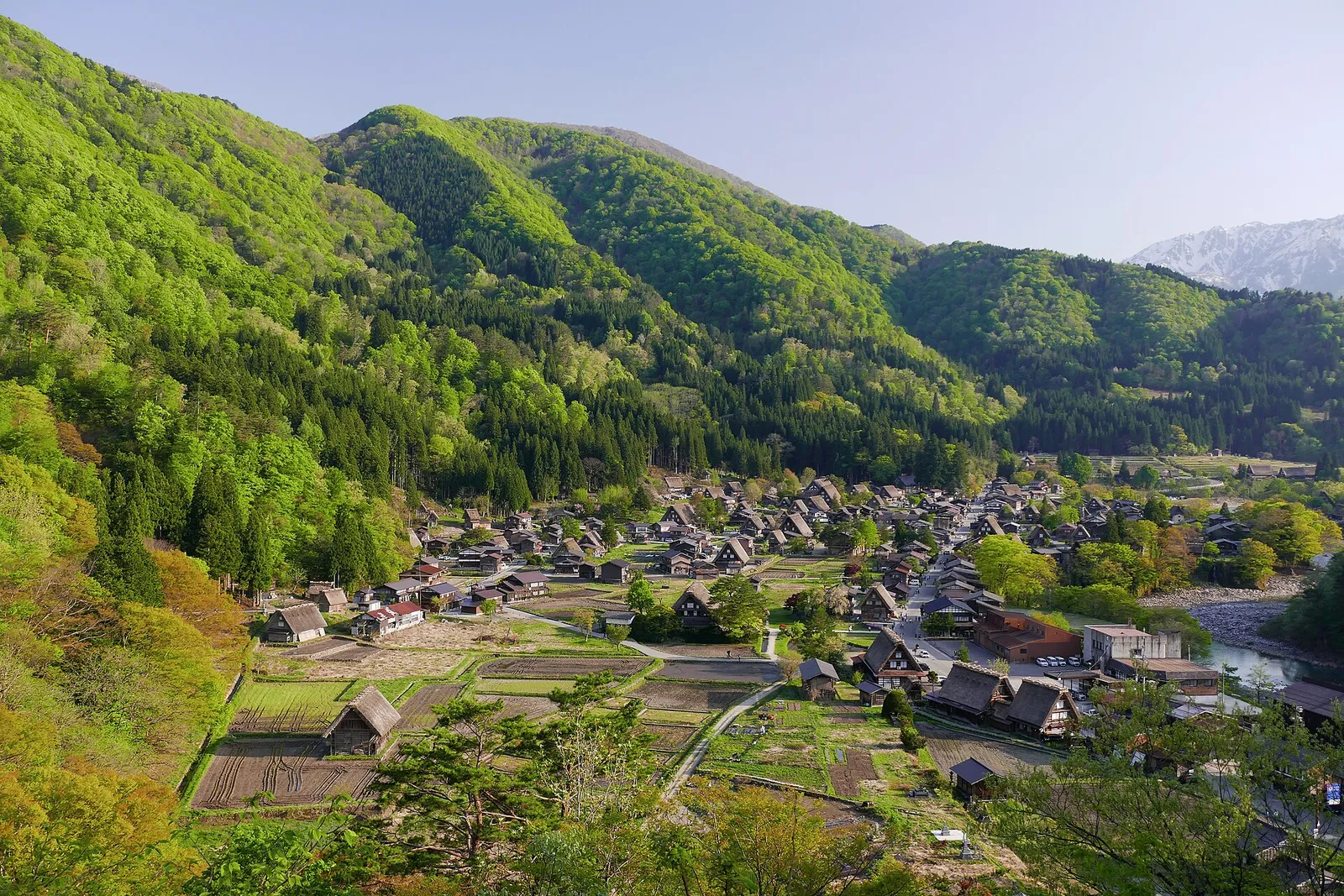
Shirakawago is a mountain village of gassho-zukuri farmhouses — huge, steeply thatched A-frame buildings erected without nails, their attics once raising silkworms — and Ogimachi, its main village of over a hundred such houses, has been UNESCO World Heritage since 1995. What makes it unusual among heritage sites is that people still live and farm in it: you walk a working village, enter two of its grandest houses, and climb to a viewpoint for the calendar-image panorama. It works as a half-day stop between Takayama and Kanazawa, but staying overnight is the real move — the light-up evenings in deep winter, admission-limited and lottery-gated, are among Japan's most sought-after winter scenes. Bring layers; this is snow country.
Top sights at a glance
No. 1
The Ogimachi Gassho Village
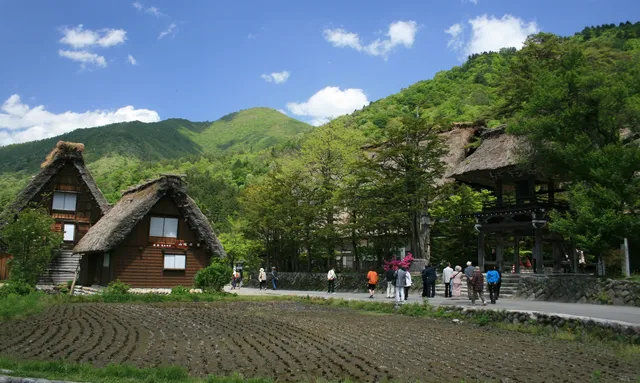
Ogimachi is Shirakawago's main village and one of Japan's most photographed landscapes: around 114 gassho-zukuri houses spread along the Sho River, their 45-60 degree thatched roofs built like hands in prayer to shed several meters of snow. The village is not a museum — residents live behind the hedges — but several houses open as museums, restaurants, and minshuku, and the lanes, fields, and temple grounds between them are free to wander. UNESCO listed it in 1995 with neighboring Gokayama, for a living farming landscape rather than buildings alone.
Good to know · Free to enter and walk; open houses charge individually (¥400 for Wada-ke and Myozenji, as of October 2026). The village is 5-10 minutes on foot from the Shirakawago Bus Terminal. Stay on public lanes, respect private homes, and go early — day-trip crowds peak 10:00-15:00 and most buses leave by 17:00.
No. 2
The Shiroyama Viewpoint
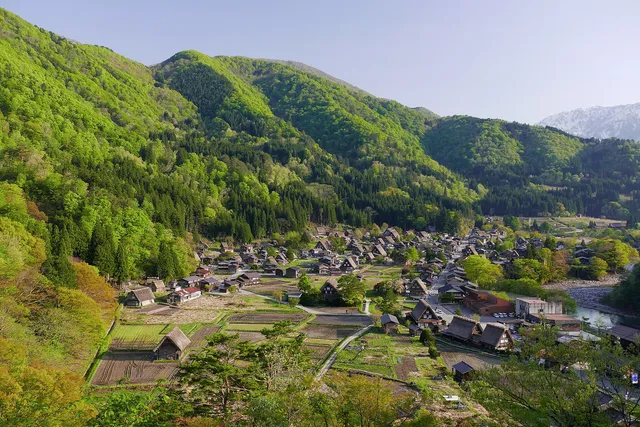
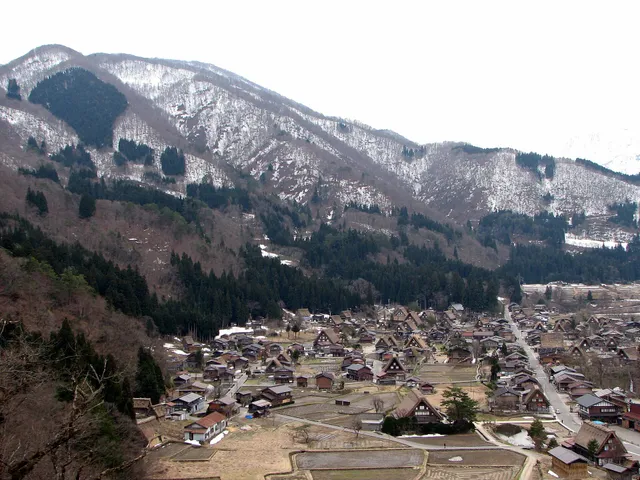
The postcard shot: a terrace partway up the valley's west wall looking down on the whole village — thatch, river, and the mountains behind — compact enough to fit in one frame. Everyone gets their photo here, which is fine, because the platform is large and the view absorbs crowds. Come for the classic midday shot, but stay for late afternoon, when low sun warms the thatch and the day-trippers have thinned; in snow season the white roofs below are the whole reason to visit this region.
Good to know · A shuttle bus runs the steep road for ¥300 one way (roughly every 15-20 minutes), or walk the signed trail up in 15-20 minutes from the village center, as of October 2026. The trail closes during and after heavy snow — take the bus in winter. Handicap of the bus: lines form at departure time on peak days; walking down is always easy.
No. 3
Wada House
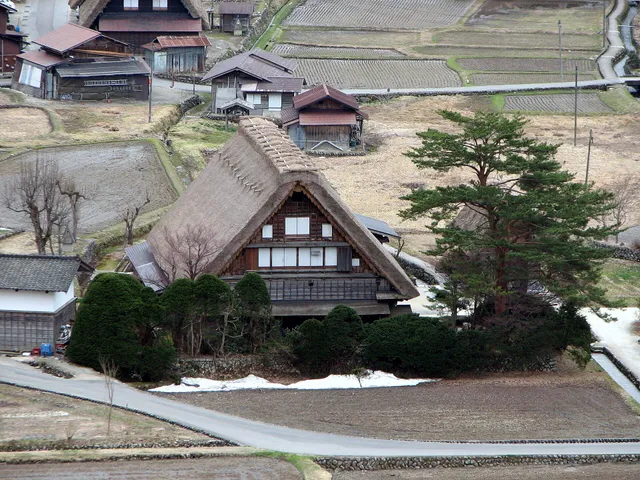
The Wada family were Ogimachi's village headmen, and their house — one of the largest gassho structures surviving, a designated Important Cultural Property — shows how the elite of this economy lived: formal rooms and family treasures on the ground floor, and above them the vast dark attic where the real money was made, in saltpeter for gunpowder, the village's key Edo-period cash trade, alongside sericulture. An irori hearth, utensils, and worn timbers make the building feel used, because it is: Wada descendants are among those who keep it open.
Good to know · ¥400, as of October 2026; look for the signposted gate one minute from the bus terminal. Take your shoes off at the entry, mind low beams and steep stair ladders in the attic, and budget 20-30 minutes. Combine with Myozenji, at the village's other end, for the full interior tour.
No. 4
Myozenji Temple & Museum
Ogimachi's temple is itself gassho-thatched — a rarity, since most temples in snow country took tiled roofs — making its great dark roof the village's most distinctive silhouette after the farmhouses. The adjacent priest's residence houses a local museum: farm tools, weaving equipment, and documents from the village's 20th-century fight against a dam project that, had it been built to plan, would have flooded the valley. It is the one place in Shirakawago that tells you why the village survived at all.
Good to know · ¥400 for temple residence and museum, as of October 2026, at the northern edge of the village below the viewpoint trail. Twenty minutes covers it comfortably; photography inside is limited, so buy a postcard of the thatched temple roof at the shop instead. Pair it with the walk up to Shiroyama, whose trail starts nearby.
See it in motion
Some places earn a moving picture
Stills can't show how this place moves — the drift, the light show, the crowd flow. We picked a recent, high-quality walkthrough rather than a promotional cut.
Shirakawago in Winter, Quiet Walk in Snowy Mountain Village | Gifu, Japan 4K
Ambient Exploration · YouTube · plays on click
Embedded via YouTube's official player (privacy-enhanced mode). Video: Shirakawago in Winter, Quiet Walk in Snowy Mountain Village | Gifu, Japan 4K by Ambient Exploration. Not affiliated with Japan Travel Navi; screened for quality and accuracy on 2026-10-06.
Shirakawago is the image of old rural Japan that most of Japan itself no longer has: a river valley of white-plastered, deep-eaved farmhouses with roofs pitched like praying hands, built to shrug off four meters of snow. The village of Ogimachi sits at the center of it — just over a hundred gassho-zukuri houses, a working community that happens to be a UNESCO World Heritage Site, an hour’s mountain bus ride from either Takayama or Kanazawa. Nearly everyone visits on a day trip, sees the viewpoint panorama, and leaves by mid-afternoon. The travelers who get more are the ones who sleep under thatch, eat at an irori hearth, and, if they win a lottery, see the village lit up at night in deep snow.
A Bit of History
The Sho River carved this valley deep and isolated it thoroughly. From at least the 1600s, its villages grew rice in the narrow floor, brewed saltpeter from the soil under their houses (gunpowder, sold through Takayama’s merchants, was the cash crop), and raised silkworms in the attics — the economic reason for the gassho-zukuri form itself: a roof steep enough, at 45-60 degrees, to shed the region’s crushing snow, and an attic large enough to work. The houses are assembled without nails, their rafters tied with cord and wire, and the village laid out with the ridges running north-south, catching summer winds and minimizing winter storm damage. The thatch itself is renewed generationally, in communal work parties called yui — an entire village turning out to re-roof a neighbor’s house.
The 20th century nearly ended it. Postwar depopulation emptied the upper valley, and in the 1960s a dam project on the Sho would have submerged several villages outright. Residents fought back — the opposition campaign is documented today inside Myozenji’s museum — and the dam was scaled down; Ogimachi survived above the waterline. Preservation followed disaster-avoidance: in 1976 the village was designated an Important Preservation District for Historic Buildings, and in 1995 Ogimachi, with Gokayama’s Ainokura and Suganuma, became a UNESCO World Heritage Site — cited not as architecture alone but as a living social landscape, “adapted … to the environment and their social and economic reasons for being” as UNESCO’s citation runs, and still inhabited.
Tourism then did what tourism does: buses arrive by the dozen in high season, and the village manages itself carefully — farmland preserved, new construction restricted, the light-up event capped by lottery. Houses still re-thatch under the yui system; a roof takes a village.
Culture & Daily Life
Remember, always, that you are walking through someone’s hometown. The houses with laundry lines and tractors are homes; the ones with signs and ticket lathes are the open ones. The etiquette that matters most: stay on the public lanes, do not photograph into doorways or windows, and treat the fields and hedges as private property — all of which is elementary but visibly tested by about two in ten visitors on a busy day. In return the village is unusually welcoming: farm cafés, hearth-cooked lunches, and minshuku that host foreigners with a warmth big-city Japan rarely matches.
The gassho house interior is worth understanding before you enter one. Ground floors held the family life — the irori sunken hearth, its fire never quite out, drying everything from fish to diapers above — while the steep stair-ladder to the attic opens into a surprising vastness of tied rafters and filtered light, where silkworm shelves lined the walls until the 1950s-70s. Winter defines the calendar: roofs compress under white, the village falls silent under meters of snow, and daily life contracts around the hearth. The re-thatching cycle continues — a house is re-roofed every few decades at community scale.
Practical realities: this is a small mountain village, so cash rules the open houses and most cafés (see /guides/money-and-payments/), buses and reservations rule the logistics, and Japanese, gestures, and patience rule the conversation. English is thin on the ground; the communication cards at /cards/ earn their keep at a minshuku dinner table.
Nature & Day Trips
The village sits in a steep green bowl in summer, a golden one in autumn, and a white one in winter — and the seasons are not cosmetic here. Snow falls in quantities that close roads and cancel buses; the light-up events of January-February exist precisely because the snow is the point. Late April to May is the green shoulder season with fewer crowds; October’s colors peak mid-month.
The walkable geography is compact: village floor, riverbank, viewpoint. Beyond it, the region divides nicely. Gokayama, over the prefectural line in Toyama, holds two quieter World Heritage hamlets — Ainokura and Suganuma — reached by the same bus line, about 45 minutes and ¥1,300 from Ogimachi, as of October 2026. They are what Shirakawago was before the tour buses: smaller, darker, with overnight options in actual farmhouses. Hirase Onsen, 15 minutes back toward Takayama, is a hot-spring hamlet with a famous free mixed open-air bath. Most travelers pair Shirakawago with Takayama to the east (/destinations/takayama/) or Kanazawa to the west (/destinations/kanazawa/), usually by through-bus between the two; our Alpine Japan itinerary threads it with Matsumoto and the Nakasendo (/itineraries/alpine-japan-itinerary/), and Nagoya is the closest big rail hub to the south (/destinations/nagoya/).
Food & Drink
Shirakawago’s table is hearth food: an irori lunch in a gassho house, with river fish and miso-paste dengaku griddled on sticks over coals, tofu and mountain vegetables simmered in the corner kettle, and pickles from the valley. Expect ¥1,200-2,500 for a set lunch at the farmhouse restaurants in and around the village — simple, warming, and built for snow. Soba is the local staple noodle, and the buckwheat fields around the village are the view on your plate; gohei-mochi (griddled rice cakes with walnut-miso) is the standard snack while walking, a few hundred yen from stalls near the bus terminal.
For souvenirs, the village’s dairy does respectable soft-serve (excellent in winter, eaten indoors), and local craft sake and umeboshi pickles fill the shops by the terminal. The splurge version of dinner belongs to the minshuku: guests eat multi-course home cooking around the host family’s hearth, with local beef or river fish and as much rice as the pot holds — one of rural Japan’s better food memories, and covered by the room price. Vegetarians are understood more than catered to; shojin-style tofu and vegetable dishes appear, but say so when booking, not at the table: 「すみません、肉と魚は食べられません。ありがとうございます。」
Top Sights
The Ogimachi Gassho Village
Start at the bus terminal, cross the river, and let the village impose its own pace — lanes between house walls and hedge rows, the temple grounds, the fields still plowed in strips. The open buildings punctuate the walk: the Wada house and Myozenji at either end, the Kanda and Nagase farmhouses (¥400 each, as of October 2026) showing silk-farming interiors, and the Gassho-zukuri Minkaen across the river, an open-air museum of two dozen relocated houses from the valley’s now-abandoned upper villages. Give the whole circuit a half-day; add the Minkaen and you have spent the day well.
Timing is everything here. Between 10:00 and 15:00 the village absorbs the bus waves — crowded at the viewpoint, dense at the main-lane shops, still quiet in the back lanes. Before 9:30 (early arrivals from Takayama) and after 16:00 (last buses gone), Ogimachi reverts to the village it is, and the light gets good. The practical schedule that works: overnight in or near the village, do the viewpoint and open houses at opening, lunch at a hearth restaurant, and the back lanes and riverbank after the crowds leave.
The Shiroyama Viewpoint
The viewpoint is a 15-20 minute signed climb on a footpath from the village’s north end, or a two-minute shuttle bus ride up the road for ¥300 one way, as of October 2026 — the trail is closed during and after heavy snow, when the bus is the only route. From the platform, the village assembles into the classic single frame: the river bending through, thatch roof behind thatch roof, forested ridge behind. It is the shot on every brochure, and it earns it.
Go twice if you can: midday for the postcard, late afternoon for warmth of light and thinner crowds. In the light-up season, note that the viewing arrangements change — attendance on event evenings is ticketed and tied to the shuttle system, so check the event details before assuming you can walk up at dusk (see the winter light-up coverage in Culture, above, and the official site for the current mechanics).
Wada House
One minute from the bus terminal, behind its gate and hedge, the Wada house is the village’s grand tour: the headman’s residence, among the largest gassho houses surviving and a designated Important Cultural Property. You enter through the kitchen end, past the irori hearth and household shrine, then climb the stair-ladder into the three-level attic where the family’s saltpeter production and sericulture ran — the rafters still sooty from three centuries of hearth smoke below. Displays explain the chemistry and economics of the gunpowder trade that kept this valley solvent through the Edo period.
¥400, shoes off, 20-30 minutes, as of October 2026. The attic ladder is steep and the beams low — bend, hold the rail, and mind your head; the view down through the tied rafters is the most complete gassho interior open to visitors anywhere. The family still maintains the house and garden, which is exactly the point of the preservation district: this is stewardship, not curation.
Myozenji Temple & Museum
At the village’s northern edge sits the one building that surprises even the guidebooks: a Buddhist temple under a gassho thatch roof, its great dark slope the only one of its kind in Ogimachi. The temple hall faces a small grove; the adjoining priest’s residence, also thatched, holds the village museum — a dense little collection of farm implements, looms, snow tools, and the documents of the anti-dam campaign that saved the valley in the 1960s-70s. It reframes everything else you have walked past: Shirakawago survives because its residents organized, and the museum says so plainly.
¥400 for the residence and museum, as of October 2026; the temple hall itself is viewed from outside except on special occasions. Twenty minutes is enough, and the viewpoint trail starts just beyond — the natural finishing climb. Photography inside is limited, but the thatched roof photographs perfectly from the lane, especially with snow on it.
Getting There & Around
There is no train; the bus is the deal. From Takayama’s Nohi Bus Center, it is about 50 minutes and ¥2,800 one way to Shirakawago, with roughly 16 round trips a day; from Kanazawa, ¥2,800; the same buses run through between Takayama and Kanazawa, making Shirakawago the mid-route stop, as of October 2026. Some departures are reservation-only (marked R on the timetable) and the rest fill anyway in peak seasons — book via Japan Bus Online or the Nohi counter in advance, and in winter take the schedule seriously: heavy snow has delayed these buses by two hours or more, and occasionally suspended them outright.
In the village, everything is on foot; the Shiroyama shuttle (¥300 one way) is the only transit. Luggage lockers exist at the bus terminal, but traveling light or forwarding bags ahead makes the day easier — hauling a roller bag between thatch houses is nobody’s memory of Japan. Driving yourself is possible in fair weather (the Tokai-Hokuriku Expressway’s Shirakawago interchange is minutes away), but parking around the village is metered, congested, and on light-up event evenings reservation-only.
Where to Stay
The two good options are opposite extremes. Sleeping in the village — in gassho minshuku converted from farmhouses or the small inns along the river — buys you the empty lanes of evening and early morning, hearth dinners, and star-thatched silence; rooms are simple futon-and-bath-down-the-hall affairs at genuinely reasonable rates for what they are. Book far ahead for snow season and festivals; the light-up evenings are lottery-gated (applications generally open in autumn on the official site; the 41st event, announced as of October 2026, runs January 11, 17, 24, and 31, 2027, with lodging allocated by lottery drawn from applications submitted October 1-31, 2026 — winners are notified November 10 and everyone else is not, so plan a fallback).
The alternative is not staying at all: base in Takayama or Kanazawa and ride the through-bus with a stop here. That is the right call for tight schedules, but it forfeits the two best hours of the village. A middle path — the hot-spring hamlet of Hirase Onsen, 15 minutes away — adds an open-air bath to the deal, at the cost of a taxi or a reservation-required shuttle. Whichever you choose, book the bus seats first: they, not the rooms, are what actually sell out.