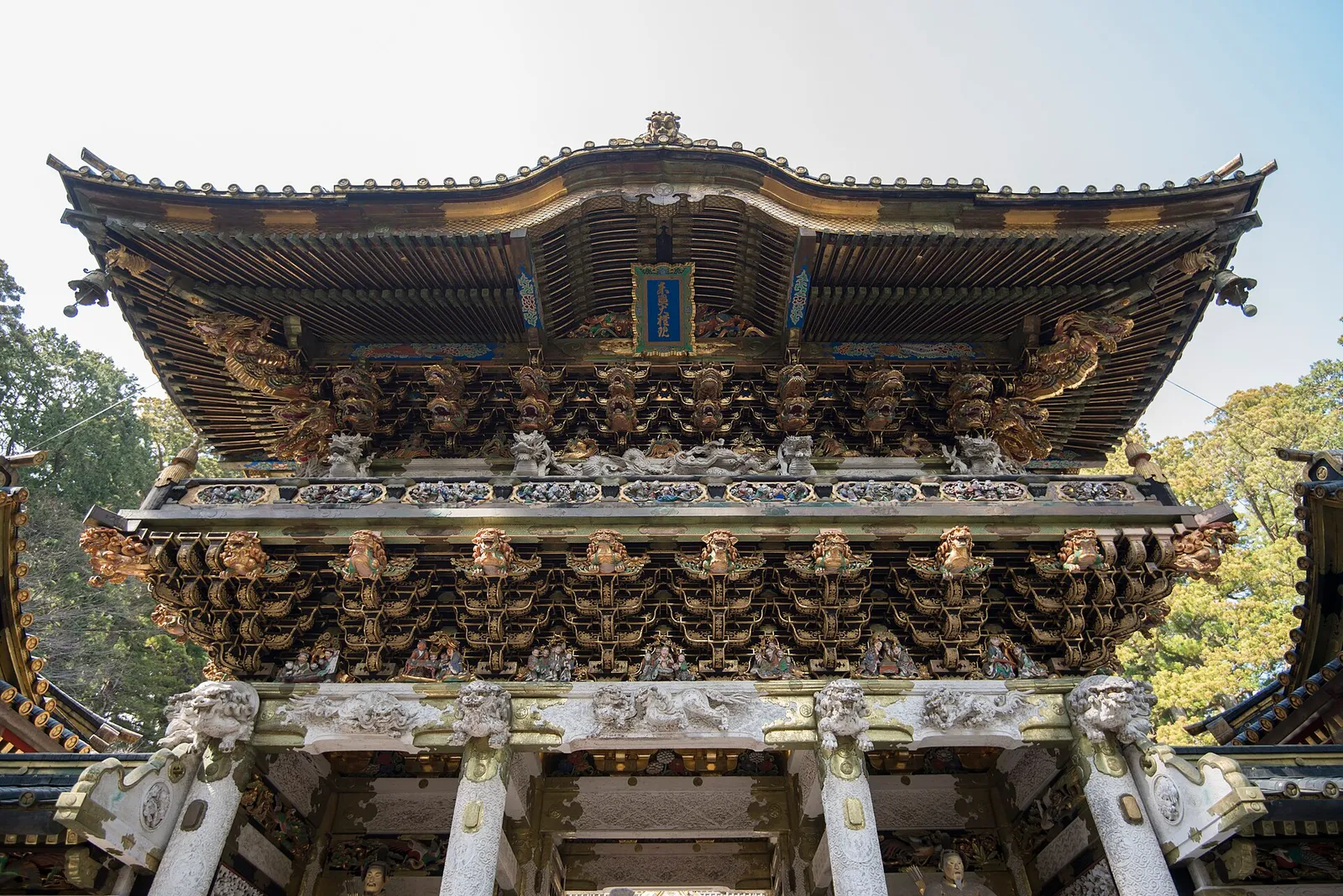
Nikko, two hours north of Tokyo in the mountains of Tochigi, is where the Tokugawa shogunate built its grandest statement: the Toshogu Shrine, the mausoleum of founder Tokugawa Ieyasu, its gates and storehouses layered in gold leaf, lacquer, and thousands of carvings — the sleeping cat and three monkeys among them — inside a UNESCO World Heritage site that also covers a sacred red bridge, an eighth-century Buddhist complex, and 12,500 cedar trees lining the approach. Ride the hairpin road up from the shrine town and the same trip turns alpine: Lake Chuzenji at 1,269 meters, the nearly 100-meter Kegon waterfall, and hot-spring villages inside Nikko National Park. It works as an ambitious day trip from Tokyo (see /guides/day-trips-from-tokyo/) and, better, as a one-night stop timed for autumn color in mid-October. Expect crowds at the shrines — this is one of Japan's most visited heritage sites — and near-solitude a bus ride higher.
Top sights at a glance
No. 1
Toshogu Shrine
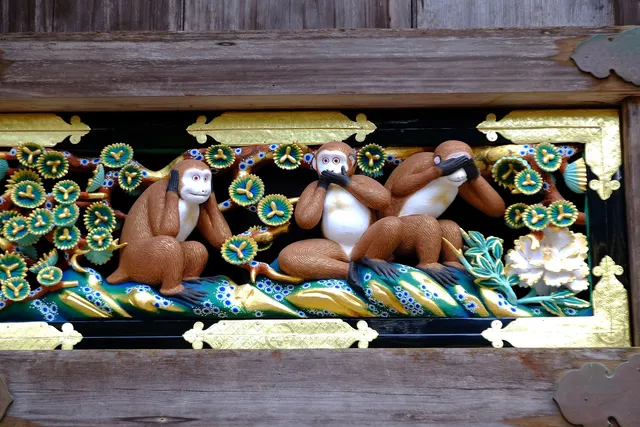
The mausoleum-shrine of Tokugawa Ieyasu, the shogun who unified Japan, moved here in 1617 per his own deathbed instruction to become the guardian deity of the eight provinces from this sacred mountain. His grandson rebuilt the complex in 1636 into what you see: over fifty structures where Shinto and Buddhist imagery share walls, and where restraint lost the argument — gold leaf, lacquer in every color, and some 5,000 carvings of sages, dragons, and imaginary beasts. The famous ones are signposted: the three wise monkeys on the stable, the sleeping cat above the Sakashita gate, and the Yomeimon, a gate so ornate the legend says viewers never finish counting its carvings — or that it went missing one legend-rich night. Climbing beyond it through cedar forest to Ieyasu's bronze-and-gold mausoleum is the quiet finale.
Good to know · Adults ¥1,600, elementary and junior high students ¥550; open 9:00-17:00 April-October, 9:00-16:00 November-March, no closing days, as of October 2026. Allow 2-3 hours including the mausoleum stairs. From Nikko stations, bus 10 minutes (¥350) to the shrine bus stop, or a 30-40 minute uphill walk past Shinkyo. A ¥500 audio guide in English is rentable just inside the Omote-mon gate.
No. 2
Shinkyo Bridge
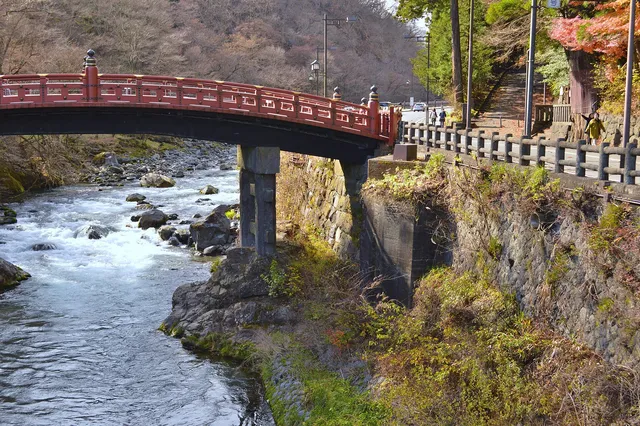
The vermilion bridge arched over the Daiya River gorge at the official gateway to Nikko's sacred area — one of Japan's oldest and most photographed bridge designs, belonging to Futarasan Shrine and closed to normal traffic for centuries; only imperial processions and priests crossed. The current lacquered structure dates from the 1636 rebuilding of the shrine complex, though a bridge has stood here since the legends of the eighth-century monk Shodo Shonin, whom the scriptures say was carried across the torrent on two giant serpents. Today it is the postcard of Nikko — red against the black pines and white rapids — and the smart visit combines a crossing with the free view from the ordinary road bridge just downstream.
Good to know · Viewing from the road bridge is free and always possible; walking across the sacred bridge itself costs a few hundred yen during daylight hours, as of October 2026. It is a 20-25 minute walk from Tobu/JR Nikko stations, on the way to Toshogu — most visitors meet it as the opening act of the shrine loop. Morning light arrives from behind the bridge; late afternoon is backlit.
No. 3
Kegon Falls
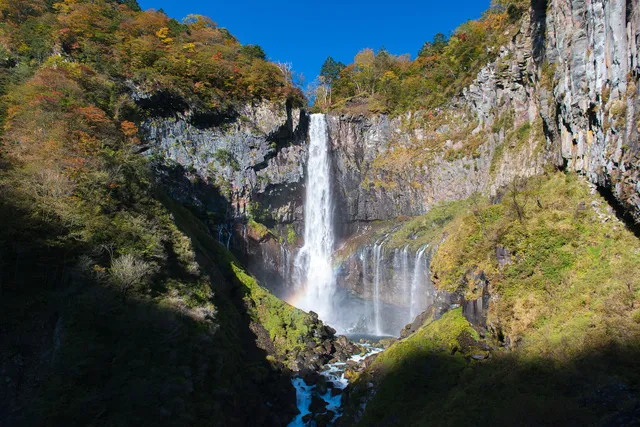
The most famous of Nikko's many waterfalls: nearly 100 meters of the Daiya River falling in a single column off the lava shelf that dams Lake Chuzenji, viewed from a free observation deck at the rim or, better, from a platform at the base reached by a paid elevator down through the cliff. From below, the water arrives as weather — spray drifts across the platform and the rock walls close in above, with the falls' narrow column framed against the sky. In winter the column freezes into a blue-white pillar; in autumn the surrounding cliffs burn with color. Twelve smaller falls appear on the cliff face to the left, giving the scene its formal composition.
Good to know · The rim observation deck is free; the elevator to the base costs ¥600, running 8:00-17:00 March-November and 9:00-16:30 December-February, as of October 2026. From Tobu or JR Nikko Station, buses toward Chuzenji Onsen take about 50 minutes (¥1,250); the falls are a 5-10 minute walk from the Chuzenji Onsen bus terminal. The elevator queue can exceed an hour on autumn weekends — go before 10 a.m.
No. 4
Lake Chuzenji
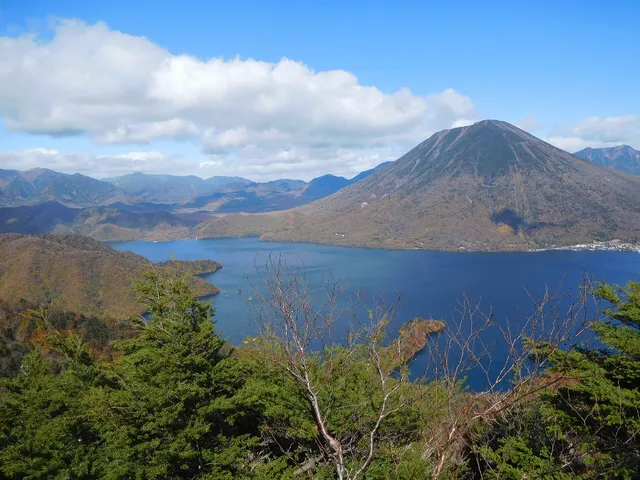
An alpine lake at 1,269 meters, created when Mount Nantai's eruption dammed its own lava flow 20,000 years ago, with the volcano's symmetric cone rising to 2,486 meters above the western shore. Because the mountains above 1,000 meters ran a full ten degrees cooler than Tokyo, the Meiji-era diplomatic corps built its summer villas on this lake — several foreign embassies' retreats survive, including an Italian villa museum open to visitors — and the same logic makes this the escape valve for the Kantō plain every summer. A one-hour sightseeing boat loops the shore, and the lakeside promenade between the Chuzenji temple and the boat dock is the easy, flat stroll most visitors take.
Good to know · The lakeshore itself is free; the hour-long sightseeing boat costs ¥1,850 and runs from the second week of April through November, as of October 2026. Buses from Nikko Station reach Chuzenji Onsen in about 50 minutes (¥1,250); a 2-day unlimited bus pass between Nikko and Chuzenji Onsen costs ¥2,300 at Tobu Nikko Station. October mid-week is the sweet spot: color without the Irohazaka traffic jams.
No. 5
Kanmangafuchi Abyss
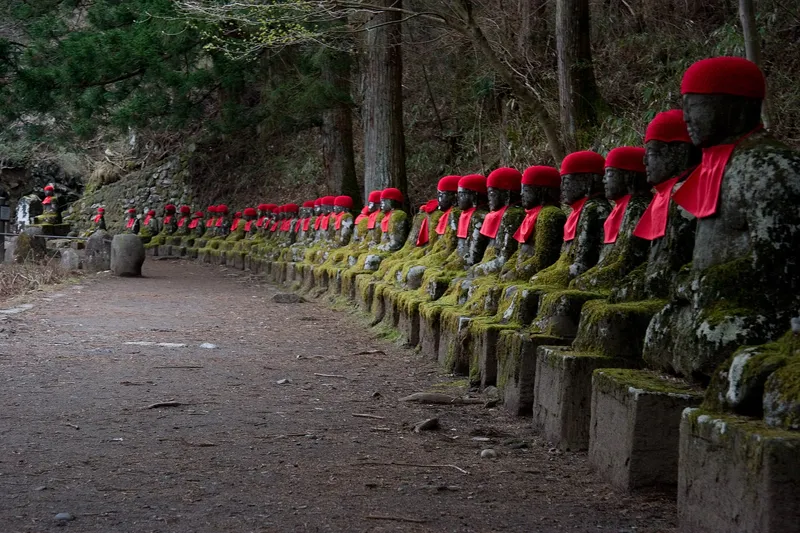
A short, wild gorge on the Daiya River, formed by an ancient eruption of Mount Nantai, where a riverside path of a few hundred meters passes a row of about 70 stone Jizo statues — the bodhisattva who protects travelers, children, and the dead — wearing moss, shawls of ivy, and the occasional knitted cap. Locals call them Bake Jizo, ghost Jizo, because of the legend that however carefully you count them, the number comes out different every time — count your own party in and out. The statues are believed to have been placed by the monk Tenkai in the seventeenth century as guardians for the shrine complex across the river, and the ravine's violence — the river sprints through a black basalt channel — makes the serenity of the stone faces land.
Good to know · Free and always open; allow 30-45 minutes for the round-trip walk. From the shrine area, it is about 30 minutes on foot via the Shinkyo bridge road, or one stop on the Chuzenji-bound bus to Tamozawa (¥350) then 10-15 minutes' walk — as of October 2026. The path is flat but unpaved in sections; go in the late afternoon when the low sun lights the statue row and the tour groups have gone.
See it in motion
Some places earn a moving picture
Stills can't show how this place moves — the drift, the light show, the crowd flow. We picked a recent, high-quality walkthrough rather than a promotional cut.
Toshogu Shrine. Walking in Nikko 🇯🇵, Japan | Tokugawa Ieyasu
SanpoSuru · YouTube · plays on click
Embedded via YouTube's official player (privacy-enhanced mode). Video: Toshogu Shrine. Walking in Nikko 🇯🇵, Japan | Tokugawa Ieyasu by SanpoSuru. Not affiliated with Japan Travel Navi; screened for quality and accuracy on 2026-10-06.
Nikko is a day trip that fights its own geography, and mostly wins. Two hours north of Tokyo, the shrine town sits in a mountain valley where the Tokugawa shoguns spent the national treasury proving their dynasty was cosmic business: the Toshogu Shrine, mausoleum of founding shogun Tokugawa Ieyasu, is Japan’s most extravagant single complex of religious architecture, gold leaf and 5,000 carvings against a black cedar forest. Then the road climbs 48 hairpins to Oku-Nikko, and the register changes completely — an alpine lake at 1,269 meters, a waterfall dropping nearly 100 meters in one go, and onsen villages inside a national park. First impressions are crowds and splendor at the bottom, near-silence at the top. It suits heritage-minded day-trippers from /destinations/tokyo/ — and rewards, far more, anyone who stays overnight in the old shrine town after the buses leave.
A Bit of History
Nikko was sacred before it was spectacular. In the eighth century the monk Shodo Shonin crossed the Daiya River gorge — on foot, according to legend, with the help of two divine serpents — and established Buddhist retreats on the flanks of Mount Nantai, the 2,486-meter volcano that dominates the area. The mountain itself became the object of worship; Futarasan Shrine still enshrines it, and for a thousand years Nikko was a mountain-religion destination, remote enough to require commitment.
The transformation came from the top. Tokugawa Ieyasu, the shogun who ended a century of civil war and unified Japan in 1600, died in 1616 leaving instructions that he be enshrined at Nikko as the guardian deity of the nation — a political masterstroke that placed the Tokugawa in the spiritual chain of mountain worship. His son had him interred modestly; his grandson Iemitsu went the other way entirely, ordering the 1636 rebuilding that produced the present Toshogu: over fifty structures, gold leaf by the sheetful, the finest craftsmen in the country working side by side with the finest artists. The message, delivered to every daimyo required to contribute funds, was that the Tokugawa were permanent. Iemitsu built his own, deliberately quieter mausoleum, the Taiyuin, across the valley as a retainer would face his lord.
The shogunate then landscaped the approach: some 12,500 cedar trees planted along the roads to the shrines, today a Guinness-recognized avenue and the reason the town smells like a forest floor. After 1868 the same mountains became part of Japan’s first generation of national parks (1934), and the Meiji aristocracy and foreign diplomats discovered that the lake plateau ran far cooler than Tokyo — the embassy villas of Chuzenji date from that era. In 1999 UNESCO listed the shrines and temples as World Heritage. Modern Nikko is a small town spread thin along the valley, with a tourist engine that doubles every October when the autumn color front arrives — an event scheduled, conveniently, top-down: color starts at the high lake in mid-October and descends to the shrine town by early November.
Culture & Daily Life
Nikko’s culture is a working fusion that elsewhere was dismantled. For most of Japanese history, Shinto and Buddhism shared sites, images, and budgets — the “Shinto-Buddhist syncretism” — and the 1868 Meiji government forcibly divorced them nationwide. Toshogu, built at the height of synthesis and protected by its shogunal pedigree, kept the mixture: a shrine where you will find Buddhist guardian kings, a pagoda, and the carved elephants and imaginary beasts of a temple’s decorative vocabulary, all around a strictly Shinto ritual core. Notice the architecture’s politics as you walk: the opulence faces the visitor at ground level, and the deeper you climb toward Ieyasu’s mausoleum, the simpler and quieter the buildings become — power performing humility at the summit.
Daily life in the shrine town runs on the rhythm of the buses. Day-trippers arrive mid-morning, fill the Omotesando and the shrine loop, and evaporate by 5 p.m., when the cedar shade takes the town back — restaurants close early, and the quiet after dusk is the argument for staying. Local food culture leans temple: yuba, the delicate tofu-skin cuisine that traveled here with Buddhist vegetarian cooking, is the town’s signature at every price level (more under Food & Drink). The mountain bureaucracy of omikuji fortunes, goshuin shrine-stamp books, and prayer tablets works exactly as at any Japanese shrine; the etiquette primer at /guides/temples-and-shrines/ covers the sequence. Cash still matters at the shrine counters and small shops; IC cards work on trains and buses but carry a couple of thousand yen for the ticket gates of the past. In the hot-spring settlements above the lake, tattoo policies vary by inn — check /guides/onsen-guide/ before booking.
Nature & Day Trips
The town’s split personality resolves above the Irohazaka, the double hairpin road that climbs 440 meters in 48 bends to the Oku-Nikko plateau. Up here the country is genuinely alpine: Lake Chuzenji at 1,269 meters under Mount Nantai’s cone, the Kegon falls dropping off the lake’s lava rim, and the Senjogahara marshland spreading northwest toward Yumoto Onsen, the highest and oldest hot-spring village in the area, about 80 minutes from Nikko Station by bus (¥1,950, as of October 2026). Trails lace the whole plateau — the flat walk around Senjogahara is the best easy hike, boardwalk over wetland with the volcano in view — and in October the entire plateau schedules its color in reverse, high to low.
For day trips beyond the shrines, the options run downhill: Kinugawa Onsen, a larger hot-spring town 20 minutes by train with family-friendly baths; Utsunomiya, the prefectural capital with the gyoza culture; and Edo Wonderland, a costume-history theme park near Kinugawa that children rate far above its brochure. Back toward Tokyo, the shrine-town-to-shrine-town pairing with /destinations/tokyo/ is covered in /guides/day-trips-from-tokyo/. Weather logic for all of it: the plateau is reliably 8-10 degrees cooler than Tokyo, fog rolls in fast off the lake, and the Irohazaka jams solid on October weekends — the weekday visit is not a suggestion.
Food & Drink
Nikko eats like a temple town with a mountain appetite. The headliner is yuba — the skin that forms on simmering soymilk, lifted off in sheets and served fresh with soy sauce, wrapped around vegetables, or as the centerpiece of multi-course Buddhist vegetarian meals at historic restaurants near the shrines (¥2,500-5,000 for the full experience; simpler yuba sets at half that). It arrived with the monks and stayed for the tourists, and the quality is consistent because the competition is old.
The rest of the local canon: soba made with mountain buckwheat, eaten cold with yuba on top; wagashi sweets — the region’s maple-leaf-shaped manju are a souvenir standard, best warm; and kanaya-style miso dengaku, tofu glazed and grilled on a stick. Around the shrine Omotesando and the station, budget ¥1,000-1,500 for lunch at a tourist-geared place, less at the standing soba counters inside the stations themselves. Up at the lake, the Chuzenji Onsen settlement’s restaurants run simpler and close earlier — the hot-spring inns serve the serious dinners. For the full temple-meal booking, reserve a day ahead through your accommodation; point-at-menu fallback is 「湯葉のコースをください」 (yuba no kosu o kudasai). Drinks-wise, local microbrews and Tochigi sake appear on menus throughout town; the water is the reason both exist. First-timer guidance generally lives at /guides/japanese-food-first-timers/.
Top Sights
Toshogu Shrine
Everything above the cash box at Toshogu is deliberate. Start at the Omote-mon, flanked by the two Nio guardian statues, and work the sequence: the five-story pagoda; the storehouse with the three monkeys (hear, speak, see no evil — a pun on the Japanese for the number eight); the sacred stable with its own monkey frieze cycle; then the Yomeimon gate, the complex’s superstar, so dense with gilded carving that one legend says a pillar was installed upside-down on purpose, to trickevil spirits into thinking the work unfinished and therefore un-curseable. Past it, the Honji-do hall’s ceiling dragon — the “crying dragon,” whose acoustics make a hand-clap beneath it resonate — leads to the shrine proper, then up through forest to the Sakashita gate with its tiny, famous sleeping cat (a carving of rest after struggle, placed on the route to warlord’s peace), and finally the mausoleum itself: bronze and gold, small, quiet.
Practicalities: ¥1,600 adults, ¥550 school-age, open 9:00-17:00 (November-March from 9:00 to 16:00), every day of the year, as of October 2026. Two to three hours at a real pace. English audio guides cost ¥500 inside the main gate and are worth it — the carving stories are the point. Get here for the 9 a.m. opening: by 11 the Yomeimon is a photo scrum. The combined ticket with the treasure museum is ¥2,400 if that interests you.
Shinkyo Bridge
Two bridges span the Daiya at Nikko’s sacred threshold: the ordinary black road bridge everyone crosses, and beside it, slightly upstream, the Shinkyo — a 28-meter lacquered vermilion arch on stone piers, mounted 10.6 meters above the water, belonging to Futarasan Shrine, crossed for centuries only by imperial messengers and priests. The pairing is the picture: red geometry, white rapids, the dark gorge pines. Eight Shodo-era legends attach to the site, the founding one involving the monk Shodo Shonin and two serpents who threw themselves across the torrent as a living bridge in 766; the physical bridge was rebuilt in 1636 as part of the shogunal construction boom and last restored in the 1990s.
You will pass it walking from the station to the shrines — that is the correct way to meet it. For the photograph, take the road bridge: shooting from beside the rapids puts the whole arch against the forest. Crossing the sacred bridge itself is possible during daylight hours for a few hundred yen, which buys you the middle-of-the-river view and, honestly, not much more than the free angle — spend the money only if the ledger of crossed-bridges matters to you. The shrine that owns it, Futarasan, has its own small paid garden across the road (¥300) with a two-centuries-old sacred tree arrangement.
Kegon Falls
The Daiya River leaves Lake Chuzenji by falling off it — nearly 100 meters in a single column, the tallest and most famous of Nikko’s forty-eight named falls. The free rim deck delivers the postcard in one step from the bus stop; the real experience is the elevator, bored through the cliff, that drops you to a platform at the plunge pool’s base. From below, the falls stop being scenery and become weather: the column booms, spray drifts, and the cliff walls with their twelve secondary falls close overhead. Winter brings the frozen-blue pillar version; summer thunderstorms swell the whole face; and in autumn the surrounding rock is a vertical color garden.
The elevator costs ¥600 and runs 8:00-17:00 (March-November) and 9:00-16:30 (December-February), as of October 2026 — capacity is small and October weekends push waits past an hour, so come before 10 a.m. or after 3 p.m. Buses from Nikko stations toward Chuzenji Onsen or Yumoto take about 50 minutes, ¥1,250; the falls are signposted five minutes from the terminal. Combine with the lake in one upward trip — they share the bus stop.
Lake Chuzenji
Chuzenji is the altitude dividend: at 1,269 meters, the lake sits where summer gives up, which is why Meiji-era diplomats built villas on its shores and why Tokyo refugees still fill it in August. The geology is a single clean story — Mount Nantai erupted some 20,000 years ago and its lava dammed the valley, and the lake, the falls, and the gorge below all descend from that one event. The cone of Nantai, closed to climbers most years to protect its shrine-status slopes, stands over the western shore like a poster volcano.
Visitors take three options: the lakeside promenade between Chuzenji temple and the boat dock, flat and forested; the one-hour sightseeing boat (¥1,850, running from the second week of April through November), which puts the villas, cliffs, and the volcano in one slow circle; and the slightly Further Field trip to the Italian Embassy Villa Memorial Park, a preserved 1930s diplomatic summer house open to visitors. Buses from Nikko reach Chuzenji Onsen in about 50 minutes (¥1,250); a ¥2,300 two-day bus pass covers the whole climb if the lake and falls share your itinerary. Bring a layer even in August — and in October, go midweek, or the Irohazaka’s 48 bends become a parking lot with scenery.
Kanmangafuchi Abyss
Where the Daiya squeezes through a basalt gorge below the shrine area, about seventy stone Jizo stand in a quiet row above the white water — moss-capped, ivy-shawled, each face slightly different, placed here in the seventeenth century as spiritual security for the mausoleum complex across the river. The count, locals insist, will not hold: number them on the way in and again on the way out, and the tally differs. This is Bake Jizo, the ghost Jizo, and the game is part of the visit — the statues are guardians of travelers and dead children, and the uncanny counting legend keeps the row a pilgrimage rather than a lawn.
The path runs a few hundred meters along the ravine, flat, unlit and unpaved in stretches, free, and effectively uncrowded after 4 p.m. Access: 30 minutes on foot from the shrine area via the Shinkyo road, or one stop toward Chuzenji on the bus to Tamozawa (¥350) and a 10-15 minute walk, as of October 2026. Wear real shoes after rain. Paired with Shinkyo and Futarasan, it makes the perfect final hour in Nikko town — the shrines’ gilded noise, then this: black rock, loud water, and seventy patient faces.
Getting There & Around
Two rail approaches from Tokyo, and the choice is real. From Asakusa, the Tobu line’s reserved limited expresses reach Tobu-Nikko in about two hours for ¥2,850-3,540 one way, and Tobu’s network sells the area passes that bundle the round trip with local buses. From Shinjuku, JR’s direct limited express does it in about two hours at ¥4,140; alternatively the Tohoku Shinkansen to Utsunomiya plus the Nikko line gets you there in about 100 minutes for around ¥5,500, covered by the Japan Rail Pass — the pass math lives at /guides/jr-pass-worth-it/. All fares as of October 2026.
In town, buses do the climbing: ¥350 per ride around the shrine area (¥600 for a day pass), and ¥1,250 / about 50 minutes up to Chuzenji Onsen, with a ¥2,300 two-day Nikko-Chuzenji bus pass at Tobu Nikko Station. The shrine area itself is walkable from either station in 30-40 minutes via Shinkyo. Full day-trip timing, including the seasonal-crowding caveats, is at /guides/day-trips-from-tokyo/; the one-line version is leave Tokyo by 7:30 a.m., or don’t bother day-tripping — stay the night.
Where to Stay
The shrine town, around JR/Tobu Nikko stations and the Omotesando, is the practical base: business hotels and historic ryokan within walking distance of Shinkyo and the Toshogu, with the evening quiet as the built-in bonus — the town after the last bus is the one the day-trippers never see. Choose this for one-night stops and day-trip logistics.
Chuzenji Onsen, up at the lake, suits a slower itinerary: small hot-spring inns on the shore, autumn color outside the window, and the falls and boat at your feet before the crowds arrive — at the cost of bus dependence and thinner dinner options. Prices peak sharply in October.
The romantic’s pick is Yumoto Onsen at the top of the plateau — an old onsen village by the marshland trailheads, 80 minutes from the station and a world away. Wherever you book, note that temple-town restaurants close by 8 p.m. and mountain buses thin out after late afternoon: dinner at your inn is the safe plan everywhere above the lake, and the onsen-choosing checklist is at /guides/onsen-guide/.
Sources & verification (9)
- https://toshogu.jp/pages/25/
- https://www.japan-guide.com/e/e3800.html
- https://www.japan-guide.com/e/e3801.html
- https://www.japan-guide.com/e/e3805.html
- https://www.japan-guide.com/e/e3806.html
- https://www.japan-guide.com/e/e3810.html
- https://www.japan-guide.com/e/e3812.html
- https://www.japan-guide.com/e/e3802.html
- https://www.japan-guide.com/e/e3803.html