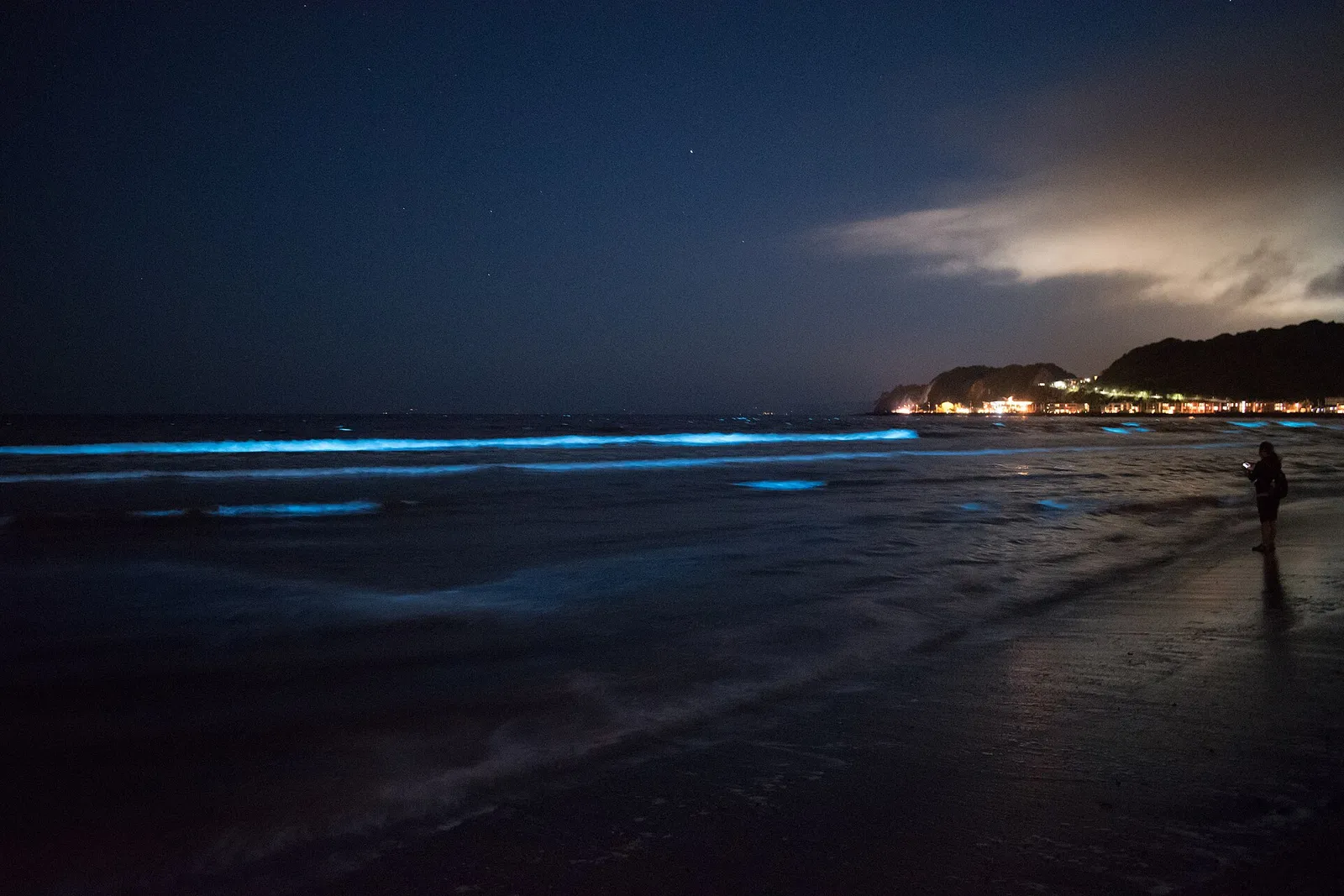
Kamakura was Japan's capital in all but name for 150 years — the seat of the country's first samurai government from 1192 — and it retains the job description perfectly: a small city of some 170,000 squeezed between forested hills and Sagami Bay, dense with Zen temples, shrines, and a 13th-century bronze Buddha that has stood in the open air for six centuries. Today it works as either an unhurried overnight stop or the most rewarding day trip from Tokyo (see /guides/day-trips-from-tokyo/), reached in under an hour by JR train. The core loop — the Great Buddha, Hasedera's hillside garden, Tsurugaoka Hachimangu, the Komachi shopping lane, and the vintage Enoden coastal tram — is walkable and tram-able in a day. Come on a weekday, and in June if you can, when the hydrangeas turn the temple stairs blue.
Top sights at a glance
No. 1
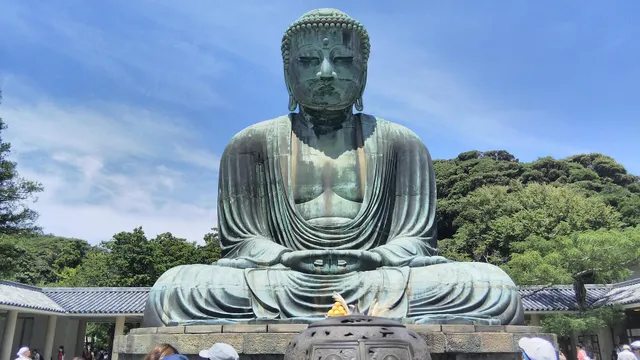
The Great Buddha of Kotoku-in
A bronze Amida Buddha cast in 1252 and sitting in the open since the wooden hall that housed it was swept away by storms and tsunami in the 14th and 15th centuries. At about 11.4 meters it is Japan's second-tallest seated bronze Buddha after Nara's Todai-ji — and unlike Nara's, you can go inside this one, ducking into the hollow casting through a rear door for ¥50 to see 750-year-old workmanship from within. The statue sits in a walled hillside garden that frames it against pines, with a small plaque-history of the hall's collapse. It survived the 1923 Great Kanto Earthquake largely intact and now anchors a visit that takes a calm, unhurried hour.
Good to know · Admission ¥300 (ages 6-12 ¥150), plus ¥50 to enter the statue interior; open 8:00-17:30 April-September and 8:00-17:00 October-March, interior until 16:30, as of October 2026. Take the Enoden from Kamakura Station three stops to Hase (about 7 minutes) and walk 7-10 minutes; from JR Kamakura, buses to Daibutsu-mae take about 10 minutes.
No. 2
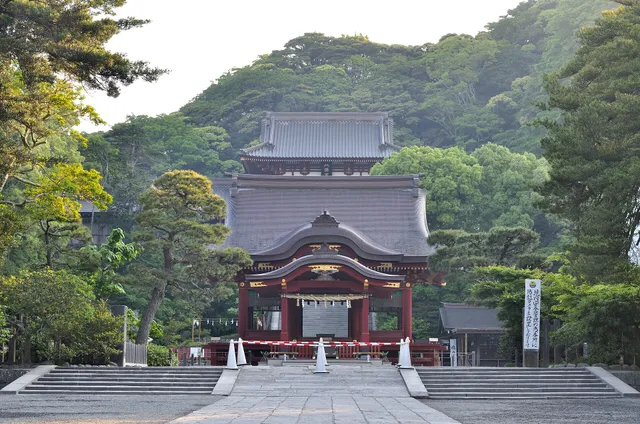
Tsurugaoka Hachimangu
Kamakura's most important shrine, founded by Minamoto no Yoritomo — the warlord who made this town a capital — in 1191 as the spiritual headquarters of his new samurai government. The approach is the sight: from the sea-side torii, the broad Wakamiya Oji avenue runs two kilometers uphill between cherry trees and azalea banks to 61 stone steps and the vermilion main hall, an procession route designed to overawe visitors arriving from Kyoto. Below the steps, the Maiden dance stage and two ponds — one for the Genji clan, one for their defeated rivals — encode the politics of the era. Ceremonies, horseback archery in seasons, and weddings still fill the courtyard.
Good to know · Grounds are free and open daily, roughly 6:00-17:00; a small museum charges admission. It is a 10-15 minute walk from Kamakura Station straight up Komachi-dori and the pedestrian avenue — arrive before 9 a.m. or after 4 p.m. to have the steps to yourself. Shrine etiquette basics are at /guides/temples-and-shrines/.
No. 3
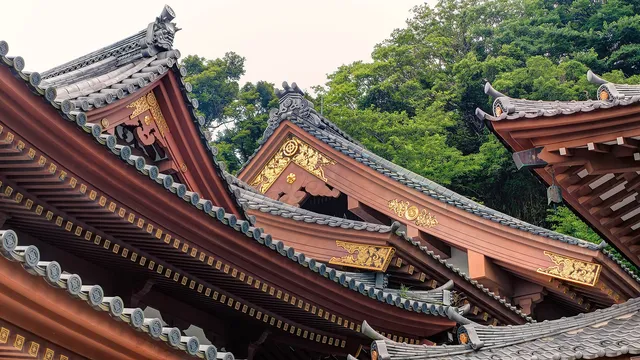
Hasedera Temple
A hillside Jodo-sect temple devoted to Kannon Bosatsu, whose gilded wooden statue — over nine meters tall, and among the largest wooden Buddha sculptures in Japan — has drawn pilgrims here for centuries, said by temple legend to have been carved from a single camphor log in the 8th century. The terraced grounds climb through a garden of hundreds of small Jizo statues, a pond of playful carp, and a viewing platform that opens suddenly onto the roofs of Hase and the Pacific beyond — the best view in Kamakura short of hiking. From late June the hydrangea path, thousands of bushes on the slope above the temple, turns the stairs blue and draws slow-moving, patient crowds.
Good to know · Admission ¥400 adults, ¥200 children (6-11); open 8:00-17:00 July-March and 8:00-17:30 April-June, with last entry 30 minutes before closing, as of October 2026. Hydrangea season (mid-June to early July) can mean a queue of 30-60 minutes at opening on weekends — arrive at 8:00 or come on a weekday. The temple is a 5-minute walk from Enoden Hase Station.
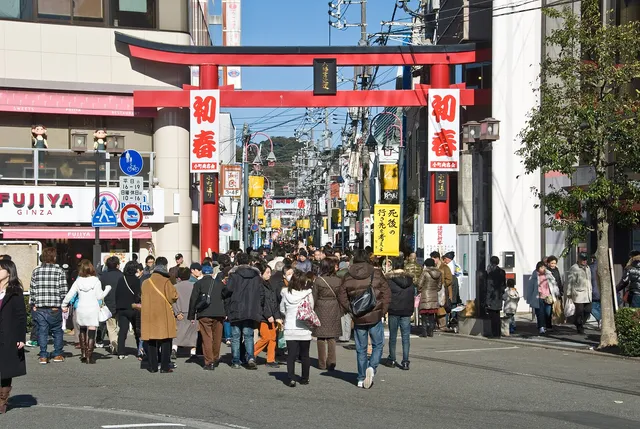
No. 4
Komachi Street
The shopping lane that runs a few hundred meters from Kamakura Station's east exit toward the shrine avenue — a compressed crash course in Japanese souvenir culture: matcha soft serve in cones and on toast, grilled squid on sticks, senbei rice crackers cracked hot off the iron, tiny shops selling the town's famous pigeon butter cookies and Kamakura-bori carved woodwork. It is touristy in the way that matters, because it is also genuinely the town's high street, and side lanes hold quieter cafes, secondhand kimono shops, and knife and ceramic stores worth the detour. Walk it once for the food, then again for the back streets.
Good to know · Free; most shops open around 10:00-11:00 and close by 18:00-19:00, as of October 2026 — evenings are quiet. Start at the station exit, graze north, and exit onto Wakamiya Oji for the shrine walk. The parallel lanes west of Komachi have the better coffee and lunch seats; point and say 「これをください」 (kore o kudasai) at any bakery counter.
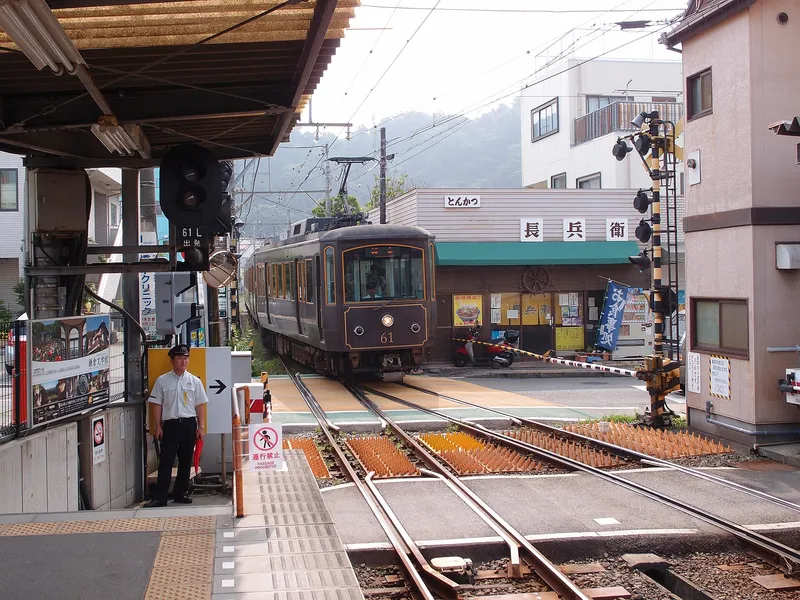
No. 5
The Enoden Railway
The Enoshima Electric Railway — Enoden — is a ten-kilometer, single-track tram-train that has connected Kamakura to Fujisawa since 1902, sometimes through residents' front yards at speeds a cyclist could match. The stretch between Hase and Enoshima is the postcard: the line breaks out of the lanes and runs on the seawall with Sagami Bay sparkling to the right and, on clear winter days, Mount Fuji stacked on the horizon. Vintage green-and-cream cars, wooden-feel interiors, level crossings where the bell dings for minutes — riding it is the thing itself, not just transport, and it links every major sight on the Kamakura side of the bay.
Good to know · A single ride costs a few hundred yen by distance (roughly ¥200-300 for most hops); the Noriorikun day pass, ¥800, covers unlimited rides plus discounts at Hasedera and other sights along the line, as of October 2026. Buy passes from machines at any station. Trains run every 10-15 minutes; Kamakura-bound cars fill up at Enoshima — board at the rear for a seat.
See it in motion
Some places earn a moving picture
Stills can't show how this place moves — the drift, the light show, the crowd flow. We picked a recent, high-quality walkthrough rather than a promotional cut.
4K Japan Seaside Village Walk - Kamakura Enoden Train Line Kanagawa Suburbs Walking Tour | HDR 60fps
World Wanderings: 4K Walking Tours · YouTube · plays on click
Embedded via YouTube's official player (privacy-enhanced mode). Video: 4K Japan Seaside Village Walk - Kamakura Enoden Train Line Kanagawa Suburbs Walking Tour | HDR 60fps by World Wanderings: 4K Walking Tours. Not affiliated with Japan Travel Navi; screened for quality and accuracy on 2026-10-06.
Kamakura is what happens when a capital loses its job but keeps the buildings. For roughly 150 years from 1192, this small bay town an hour south of Tokyo was the seat of Japan’s first warrior government, a Kyoto rival with its own shogun, bureaucracy, and five great Zen monasteries. The government fell in 1333; the temples, shrines, and hills stayed. What visitors get now is Japan’s most walkable concentration of medieval history — a giant bronze Buddha, a samurai shrine on a raised avenue, temple gardens climbing wooded slopes — wrapped in a lived-in seaside town of surf shops and old kissaten, all connected by a century-old coastal tram. It suits day-trippers with stamina and, even more, anyone who stays the night after the trains take the crowds home.
A Bit of History
In 1180, Minamoto no Yoritomo — a samurai whose family had been destroyed in a Kyoto power struggle a generation earlier — set up his base in Kamakura, a defensible valley town backed by hills and open to the sea. Twelve years later the emperor granted him the title of shogun, and for the first time real power in Japan moved out of the court and into the hands of a warrior class. Kamakura became the capital in every sense but the ceremonial: a city of maybe 100,000 at its peak, with government offices, warrior estates, and a firewall of Zen monasteries whose abbots doubled as diplomats and China-trade brokers.
The era gave Japan cultural furniture it still uses. Zen arrived properly here — meditation, ink painting, swordsmanship as spiritual practice — along with the stern, simple aesthetics the warrior class preferred to courtly gold. The Kamakura period’s sculpture style, realistic and muscular, produced some of the greatest Buddhist statuary in the country, the Great Buddha included: cast in 1252, it originally sat in a vast wooden hall that storms and a 1498 tsunami destroyed, leaving the bronze standing in the open ever since.
The shogunate collapsed violently in 1333, and Kamakura spent the next five centuries as a provincial temple town — which is precisely why so much of it survives; nothing afterward was worth building here. The modern revival came with the railway in 1889 and the writers and politicians who moved in for sea air and proximity to Tokyo, giving the town a literary afterlife as home to a colony of novelists between the wars. The 1923 Great Kanto Earthquake damaged the region badly, the Buddha included, but the town rebuilt along its old lines.
Today Kamakura is a city of about 170,000, half temple town, half commute-and-surf suburb, and Japan’s model for heritage density: twenty-plus major temples and shrines inside a walkable basin. Read it alongside /destinations/tokyo/ — the same history, told in wood and bronze instead of neon.
Culture & Daily Life
Kamakura runs at temple time. Businesses open late, close early, and shut entirely for the New Year rush, when millions walk from the station to Hachimangu for the year’s first shrine visit — the town’s biggest annual event by an order of magnitude. The rest of the year, the rhythm is set by weekends: Saturday brings day-trippers from Tokyo until Komachi-dori is a slow river of matcha ice cream, and Sunday evening returns the town to its residents. Plan accordingly — every temple below is 50% better at 8 a.m.
The town’s culture is Buddhist in a casual, municipal way. Monk-run preschools, temple cemeteries holding samurai-era graves, sutra copying (shakyo) offered at several temples for a small fee — try it at Hasedera with a brush, a model sheet, and an hour; the monks correct nothing and judge no one. Shrine etiquette matters more here than in Tokyo because the shrines are national-grade: bow at the torii, rinse hands and mouth at the font, two bows, two claps, one bow at the hall. The full primer is at /guides/temples-and-shrines/.
Practicalities are small-town Japanese: most places take IC cards and credit cards, but the croquette stands, shrine stalls, and some old cafes are cash-first — carry a few thousand yen. English is thinner on the ground than in Tokyo; the printable phrase cards at /cards/ earn their space, especially 「すみません」 (sumimasen) to open any interaction and 「これをください」 (kore o kudasai) to buy anything pointed at. Surf culture is the other half of local identity — Yuigahama and Shichirigahama beaches are beginner-friendly in summer, with board rentals along the shore road from July through September.
Nature & Day Trips
The town’s setting is its quiet superpower: the hills that once defended the shogunate are now hiking trails, and several routes link temples on foot through cedar and bamboo. The Daibuts hiking course from Jochi-ji temple to the Great Buddha takes under an hour through forest with the odd fence-side persimmon tree — the best way to arrive at the statue, and downhill at that. The longer Kamakura Alps ridge walk connects Tsurugaoka Hachimangu’s hills to Zaimokuza beach.
South along the bay, Enoshima island — reached across a short pedestrian causeway or by the Enoden — stacks a sea tower, botanical garden, caves, and a lighthouse garden onto a rock linked to Benzaiten legend; pair it with the Enoshima aquarium if traveling with kids. West of town, Fujisawa and the Shonan coast open up beach-town cycling. But the truth is most visitors’ best nature here is involuntary: the view from Hasedera’s terrace, Fuji on the winter horizon from the Enoden seawall, and June, when the hydrangeas at Hasedera and Meigetsu-in near Kita-Kamakura — the famous “hydrangea temple” — make the hillsides worth the queue. Season timing is covered at /guides/best-time-to-visit/.
Food & Drink
Kamakura eats like a fishing town with a temple income. The signature is shirasu — whitebait, boiled fresh at the harbor and served over rice (shirasu-don, ¥1,200-2,000) or mixed raw with grated ginger at harbor-side restaurants between the Enoden and the beach. Season matters: the raw version disappears during the winter fishing moratorium, when bowls come with the boiled catch instead.
Beyond the bowl: Kamakura’s cafe culture is genuinely distinguished — old-school kissaten in converted storehouses, third-wave espresso along the back lanes, and craft bakeries so confident they close when the flour runs out. Budget ¥1,000-1,500 for a bakery lunch with coffee. The town’s vegetable brand, Kamakura yasai, shows up on pizza and in tempura at restaurants along Komachi’s side streets. For souvenirs, the pigeon butter cookie (hato sabure) has been the standard since 1894 and is sold everywhere along Komachi-dori; the modern move is the matcha soft serve with azuki, one per walk. Dinner skews casual and closes early — many kitchens take last orders by 20:30, so eat before 8 p.m. or plan on a convenience-store dinner. First-timer food guidance lives at /guides/japanese-food-first-timers/.
Top Sights
The Great Buddha of Kotoku-in
The Daibutsu needs no interpretation — it is a 13th-century bronze giant sitting on a hill, 11.4 meters of casting that has watched the town from the open air since its hall washed away. Cast in 1252 in a period when Kamakura’s workshops produced Japan’s most muscular sculpture, the Amida Buddha greets with a posture of complete calm, hands raised in a mudra of welcome; the scale is felt rather than measured, especially from the lower garden path looking up. The ¥50 interior peek is worth ten minutes — the inside shows the casting joints and the patches from 700 years of repairs, including post-1923 earthquake reinforcement — though the low doorway and summer heat make it optional for the claustrophobic.
Practicalities are simple: ¥300 admission (¥150 ages 6-12), open 8:00-17:30 April through September and 8:00-17:00 October through March, interior 8:00-16:30, as of October 2026. Ride the Enoden from Kamakura Station three stops to Hase, then follow the signs 7-10 minutes on foot, or take a bus from the station’s east exit to Daibutsu-mae. The approach lane sells grilled sweet potato and pickles; the temple itself asks for quiet, and gets it. Pair it with Hasedera — 8 minutes apart on foot — for the town’s best one-two.
Tsurugaoka Hachimangu
Yoritomo built his shrine at the top of the town’s spine, and every visitor since has walked the route he designed. From the second torii at the coast, Wakamiya Oji — the processional avenue, nearly 20 meters wide at its start — climbs two kilometers past the baseball field that was once his palace’s riding grounds, through the flagstone dance stage and twin ponds, up the 61 steps to the vermilion hall, rebuilt in the 1820s on 12th-century foundations. The reward at the top is not just the shrine but the reverse of the view: the avenue, the town, the sea. On September 16 the steps host mounted archery; most weekends host weddings mid-morning, processions of white and vermilion worth pausing for.
The grounds are free, open roughly 6:00-17:00. A 10-15 minute walk due north from Kamakura Station — straight up Komachi-dori, then the pedestrian avenue; you cannot get lost because everything funnels here. Go early or late: midday weekends put a crowd on the steps that the shogun did not intend. The small museum charges a few hundred yen; the ponds — Genji with its lotus, Heike with its irises — are the better spend of time.
Hasedera Temple
Hasedera is Kamakura’s most complete visit: garden, art, view, and atmosphere on one hillside. Enter past the bent pine and the jizo garden — hundreds of small stone figures placed for children who died young, dressed in red knitted caps by their families, weathering slowly into moss — then climb the terraced path to the Kannon-do hall, home to the gilded nine-meter wooden Kannon carved, legend says, from a single camphor log in 736. (Photography inside is not permitted; the memory holds.) Higher still, the observation terrace opens over Hase’s tiled roofs to the bay, and on clear winter afternoons to Izu Oshima island and Mount Fuji’s shoulder.
Admission is ¥400 for adults, ¥200 for children, hours 8:00-17:00 (July-March) and 8:00-17:30 (April-June), last entry 30 minutes before closing, as of October 2026. Mid-June to early July, the hillside hydrangea path opens with extended crowding — arrive at 8:00 or accept a queue; the thousands of bushes are the region’s best show. The temple is five minutes on foot from Enoden Hase Station, level ground to the Great Buddha beyond it. Give it 60-90 minutes; the restaurant on the terrace does simple udon with a view.
Komachi Street
Every Japanese tourist town has one signature shopping street, and Komachi-dori is among the best — because it is short (a few hundred meters), dense, and serious about food. The classics: senbei crackers toasted on griddles and sold hot; octopus and squid skewers; matcha soft serve, including the improbably good roasted-tea version; croquettes from stores that have fried nothing else for decades. Interspersed are Kamakura specialties — hato sabure pigeon cookies, Kamakura-bori lacquered carving, indigo goods — and enough purikura and claw machines to keep teenagers loyal. It is, unapologetically, a machine for separating day-trippers from coins, and it does its job with charm and no rudeness.
Walk it with an appetite and low commitment: shops open around 10:00-11:00 and shut by 18:00-19:00, as of October 2026. The smart pattern is one pass north for the spectacle, then duck into the parallel lanes west for lunch — converted storehouse cafes, a famous croquette counter, coffee roasted on the spot — at two-thirds the crowds. Exit the far end onto Wakamiya Oji and continue north to Hachimangu; the geography makes the decision for you.
The Enoden Railway
The Enoden is a working antique: a 10-kilometer, single-track line from Kamakura to Fujisawa that runs vintage-styled green cars every 10-15 minutes, sometimes down lanes so narrow the warning bell seems addressed to individual garages. Opened in 1902, it survived the 1923 earthquake and every attempt at modernization; it is now legally and emotionally inseparable from the town’s identity. The ride itself is the attraction — the Kamakura end tunnels through the residential hillside from Hase to Yuigahama, then the line takes to the seawall at Shichirigahama and Enoshima, one of the great five-minute train views in Japan, with Fuji visible on clear winter mornings across the bay.
Ride it with a plan, not as a commute. Single fares run by distance — roughly ¥200-300 per hop — and the Noriorikun day pass (¥800) covers unlimited rides plus small discounts at Hasedera and other sights, as of October 2026, bought from station machines. The classic tourist circuit is JR to Kamakura, walk/shrine, Enoden to Hase for the Buddha, Enoden on to Enoshima for the sunset, then JR home from Fujisawa. Kamakura-bound trains board heaviest at Enoshima — stand near the rear doors and you will get a seat within two stops.
Getting There & Around
From Tokyo, the JR Yokosuka Line runs direct from Tokyo Station to Kamakura in just under an hour for ¥1,040 — the default choice, covered by IC card and by the Japan Rail Pass if you hold one (see /guides/jr-pass-worth-it/ for whether you should). From Shinjuku, the Shonan-Shinjuku Line does it in about an hour (¥1,040) on trains bound for Zushi, roughly two an hour, otherwise change at Ofuna. The budget-scenic alternative is Odakyu’s Enoshima-Kamakura Free Pass, ¥1,640 from Shinjuku, covering the round trip to Fujisawa plus unlimited Enoden rides — a slower route that pays off if Enoshima is on your list; fares as of October 2026. Full day-trip logistics are at /guides/day-trips-from-tokyo/.
In town you walk, and the geography helps: station to Hachimangu is 10-15 minutes, the Buddha and Hasedera a ¥200-300 Enoden hop or a 25-minute walk. Bicycles rent by the day around the station for the flat run to the beach. Taxis exist and are unnecessary. If you are day-tripping, start before 9 a.m. — trains fill from 10, and the return Yokosuka Line at 6 p.m. is standing-room-to-Tokyo.
Where to Stay
Around Kamakura Station for the practical one-nighter: business hotels and guesthouses within five minutes of the east exit put the shrine, Komachi, and every train at your feet, and the evening restaurant rows survive the early closings better than anywhere else. Choose this if Tokyo is your base and you have simply stayed too late.
Hase and the Yuigahama beach side for atmosphere: small ryokan, surf lodges, and guesthouses a short walk from the Great Buddha and the sand, quieter at night and best in the early morning, when the temple lanes belong to you. Prices run higher than the station area in summer and on weekends.
The connoisseur’s pick is the Enoden’s mid-section — around Gokurakuji and Zaimokuza — where restored old houses operate as boutique inns; you trade convenience for the Kamakura of the literature colonies. One rule overrides all of it: staying overnight beats day-tripping here, because the town you came for starts at 5 p.m., when the crowds board their trains back to /destinations/tokyo/.